
Introduction
Health and wellness usually gets sold as a list of separate problems. Sleep over here, food over there, stress somewhere else entirely. In practice they lean on each other, which is why one-topic advice so often contradicts the next.
This page is the front door to LookAmaze’s Health & Wellness section. It explains what the eight areas below cover, how they connect, and where to start. There is no diagnosis here — each section links out to the article that goes deeper. And where a claim rests on medical evidence, the source sits right beside it so you can check it yourself. Read the whole page if you are starting fresh, or jump straight to the area that matches your problem.
How the 8 areas fit together
These eight areas overlap more than they divide, and the overlaps are where most of the practical answers sit. That is worth a minute before you open any one section.
Start with sleep. It sits underneath almost everything else. Run short on it and appetite shifts, mood flattens, focus goes, and small problems start to feel large. The US Centers for Disease Control and Prevention links insufficient sleep to chronic conditions including type 2 diabetes, heart disease and depression (CDC), and the National Heart, Lung, and Blood Institute explains how your body clock decides when you sleep (NHLBI). Improve sleep and several other problems tend to ease as a side effect.
Eating and digestion are a pair. What you eat shapes how you feel after a meal, and how well you digest shapes what you are willing to eat next time. Fibre shows the loop clearly — it is the part of plant foods your body cannot fully break down, and it helps both bowel regularity and blood sugar and cholesterol (Mayo Clinic).
Your gut talks to your brain as well. Harvard Medical School’s health publication calls the two intimately connected, which is why stress so often lands in your stomach (Harvard Health).
Immunity is not a supplement you buy. It runs on sleep, food, movement and stress — the unglamorous inputs. The NIH Office of Dietary Supplements sets out what the evidence actually supports (NIH ODS).
None of it holds without routine, and consistency matters more than intensity. Physical activity guidance is blunt about this: some movement beats none, and the weekly total matters more than any single session (World Health Organization).
These areas affect each other in ordinary, everyday ways. A short night makes the next day’s food choices worse. A stressful week changes what your stomach does. Uncomfortable digestion makes you eat less of the things that would help. Hardly anything here happens in isolation, which is why a change in one area often shows up as an improvement in another.
Women’s and men’s health are not separate systems either. Hormones, muscle mass, metabolism and stress responses shift with age and differ by sex, which is why this section keeps dedicated guides instead of pretending one size fits everyone.
What this section covers
Here are the eight areas. Each one says what it is for and points you to the main article, so you can go straight to the depth you need.
Healthy Eating

What a balanced diet looks like in practice, how to read a label, and how to eat well without giving up food you like. The basics article covers whole foods, protein, fibre, fats and hydration, and the current Dietary Guidelines for Americans describe the wider pattern this section follows (Dietary Guidelines). Start here: Healthy Eating Basics: What a Balanced Diet Really Looks Like. If label claims leave you squinting, how to read the Nutrition Facts panel is the practical companion.
Gut & Digestion
How digestion works, what symptoms can and cannot tell you, and when something deserves a doctor rather than a home remedy. For the mechanics, the NIDDK explains your digestive system and how it works (NIDDK), and Johns Hopkins Medicine covers the brain-gut connection (Johns Hopkins). Start here: Digestive Health: A Guide to Your Gut and When to Get Medical Help. For bloating, gas and heartburn specifically, see what can help at home and when to see a doctor.
Daily Wellness

The small repeatable routines that quietly set the tone for everything else — light, movement, meals, water, winding down. Start here: The Minimum Effective Daily Wellness Routine, which strips a routine down to the smallest version that still works.
Sleep Improvement
Why timing and quality matter more than raw hours, and what actually moves them. The American Academy of Sleep Medicine’s healthy sleep habits are a sound baseline (AASM). Start here: Afternoon Slump: Why You Crash Midday and How to Fix It Without More Coffee. Still exhausted after a full night’s sleep? Read why you are still tired after 8 hours. If evenings are the problem, start with evening routines that improve sleep.
Home Remedies
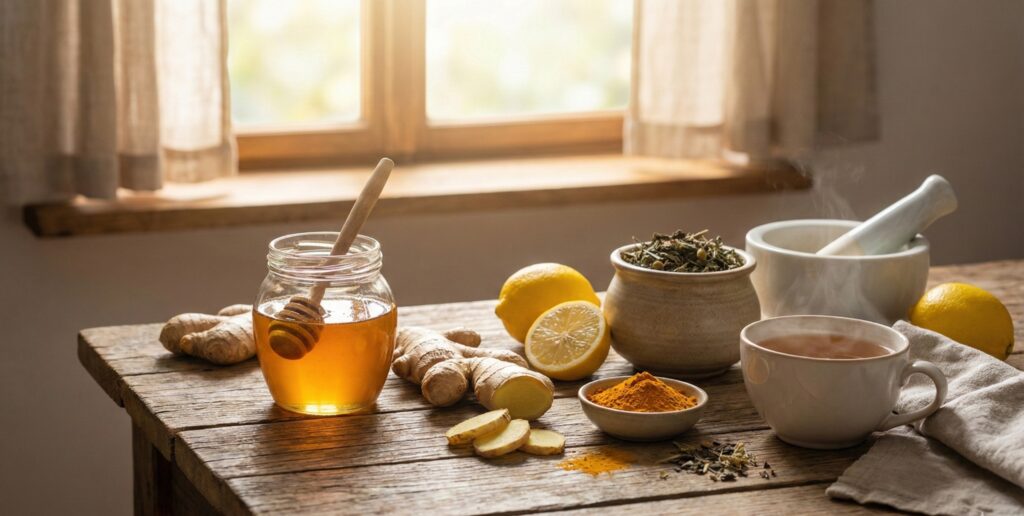
What simple household measures can reasonably do — and, just as often, what they cannot. This section stays deliberately cautious. The NIH National Center for Complementary and Integrative Health notes that oral ginger can cause side effects including abdominal discomfort (NCCIH), and that probiotics have particular uses and safety questions rather than broad benefits (NCCIH). Start here: Home Remedies for Minor Symptoms: What Can Help — and When to Get Medical Care.
Immunity
What genuinely supports immune function, and what is marketing. The evidence is strongest on the basics: the NIH Office of Dietary Supplements reviews which nutrients matter and where claims outrun the data (NIH ODS), and Harvard’s Nutrition Source lands in much the same place on nutrition and immunity (Harvard Nutrition Source). Start here: Can You Really Boost Your Immune System? What Actually Helps. For the food side, see the best foods for your immune system.
Women's Health
Cycle changes, period pain, shifts in digestion, and how long-running stress can hit women differently. The American College of Obstetricians and Gynecologists explains the role of prostaglandins in painful periods (ACOG) and what heavy or abnormal bleeding is worth raising with a doctor (ACOG). Start here: Women’s Health: What This Section Covers and When to Get Medical Help. For cycle symptoms specifically, see period problems that need attention.
Men's Health
Muscle mass, testosterone, metabolism, and the checks men tend to put off. The Endocrine Society notes that low testosterone is associated with reduced muscle mass and strength (Endocrine Society), and Cleveland Clinic explains how metabolism works and why it changes (Cleveland Clinic). Start here: Men’s Health: What This Section Covers and When to Get Medical Help. For strength, see muscle loss after 30 in men.
Which guide should you read first?
Most people arrive with a symptom or a goal, not a category. Use this list.
You wake tired, or crash mid-afternoon. Start with the afternoon slump, then still tired after 8 hours.
Bloated, gassy, or uncomfortable after meals. Start with gas, bloating and heartburn, then what digestive symptoms can and cannot tell you.
Always catching colds and wondering what helps. Start with what actually helps your immune system, then the food evidence.
Eating reasonably, but want the basics right. Start with healthy eating basics, then eating well without giving up foods you enjoy.
Want one change that lifts several things at once. Start with the minimum effective daily wellness routine.
Period pain, cycle changes, or a shift in digestion. Start with the women’s health guide, then period problems.
If you are a man noticing changes in strength, energy or weight. Start with the men’s health guide, then low testosterone signs.
When medical advice matters
None of this replaces a clinician. Some symptoms should not wait for a home experiment.
Chest pain is the clearest example. It must never be assumed to be reflux (NHS). Needing heartburn medicine more than twice a week is itself worth discussing (Mayo Clinic). Persistent or severe stomach pain, unexplained weight loss, blood in your stool or vomiting should be assessed rather than managed at home (NHS).
For women, heavy or abnormal bleeding, and pain that interferes with daily life, are worth raising rather than tolerating (ACOG). For men, persistent fatigue, mood changes or lost strength can have causes worth testing instead of guessing (Endocrine Society).
Sleepiness is a safety issue, not just an annoyance. The American Academy of Sleep Medicine documents the risks of driving while drowsy (AASM). Chronic stress has physical effects too, described by the American Psychological Association (APA) and by Harvard Health on the stress response (Harvard Health).
How to use this section
Treat this page as a map you come back to rather than something to read once. Pick the area closest to your problem, read the linked article, and give the change a few consistent weeks before deciding whether it helps. Almost nothing here is dramatic. Most of it is cumulative, which is why one change held for a month usually tells you more than five started at once.
Be careful with supplements and “detox” products. Regulated claims on labels mean specific things (FDA), and the NIH’s complementary health centre maintains that cleanses are not supported as necessary for health (NCCIH).
Final Thought
Health is rarely one decision made once. It is mostly ordinary choices, repeated often enough to matter. The point of this section is not to make you perfect — it is to help you find the few changes that fit your life and keep them, with sources you can check and clear guidance on when to see a doctor instead.
Start with whatever is bothering you most. The rest tends to follow.
Sources
- CDC — About sleep
- NHLBI — Sleep deprivation and the body clock
- Mayo Clinic — Dietary fiber (in-depth)
- Harvard Health — The gut-brain connection
- NIH ODS — Immune function (health professional fact sheet)
- World Health Organization — Physical activity (fact sheet)
- Dietary Guidelines — DietaryGuidelines.gov
- NIDDK — Digestive system: how it works
- Johns Hopkins — The brain-gut connection
- AASM — Healthy sleep habits
- NCCIH — Ginger
- NCCIH — Probiotics: usefulness and safety
- Harvard Nutrition Source — Nutrition and immunity
- ACOG — Dysmenorrhea: painful periods
- ACOG — Heavy and abnormal periods
- Endocrine Society — Hypogonadism
- Cleveland Clinic — Metabolism
- NHS — Chest pain
- Mayo Clinic — GERD: symptoms and causes
- NHS — Stomach ache
- ACOG — Abnormal uterine bleeding
- AASM — Drowsy driving
- APA — Stress effects on the body
- Harvard Health — Understanding the stress response
- FDA — Label claims for conventional foods and dietary supplements
- NCCIH — Detoxes and cleanses: what you need to know