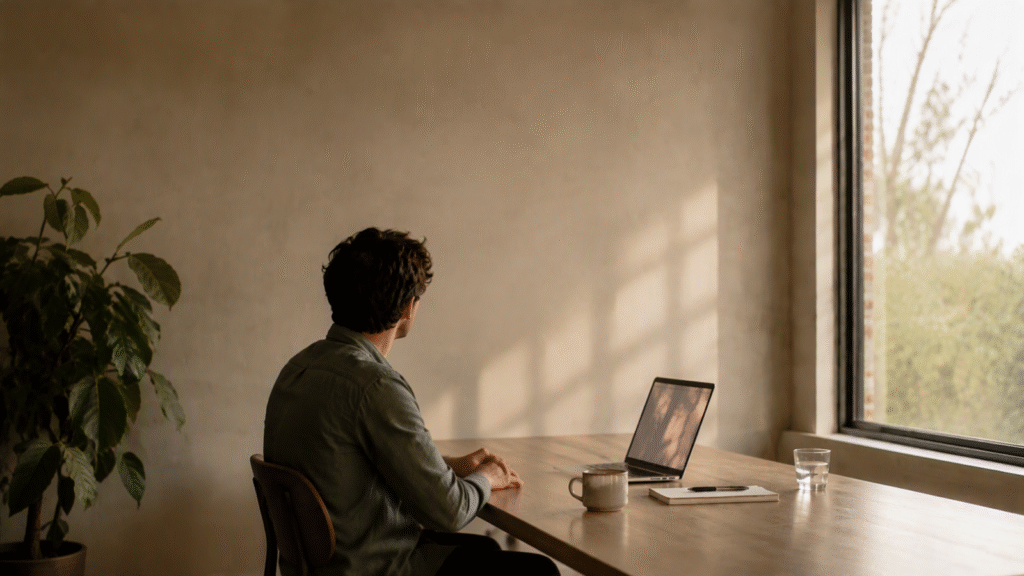
It happens somewhere in the middle of the afternoon. The morning was fine. Then the sentence you’re reading stops going in.
You read it twice. You reach the end of a paragraph with no memory of it. You stand up for coffee mostly because standing up is the only thing that has worked in the last hour.
Here is the part that usually gets skipped: the timing of that crash is not random, and lunch isn’t the whole explanation.
The dip arrives whether or not you ate
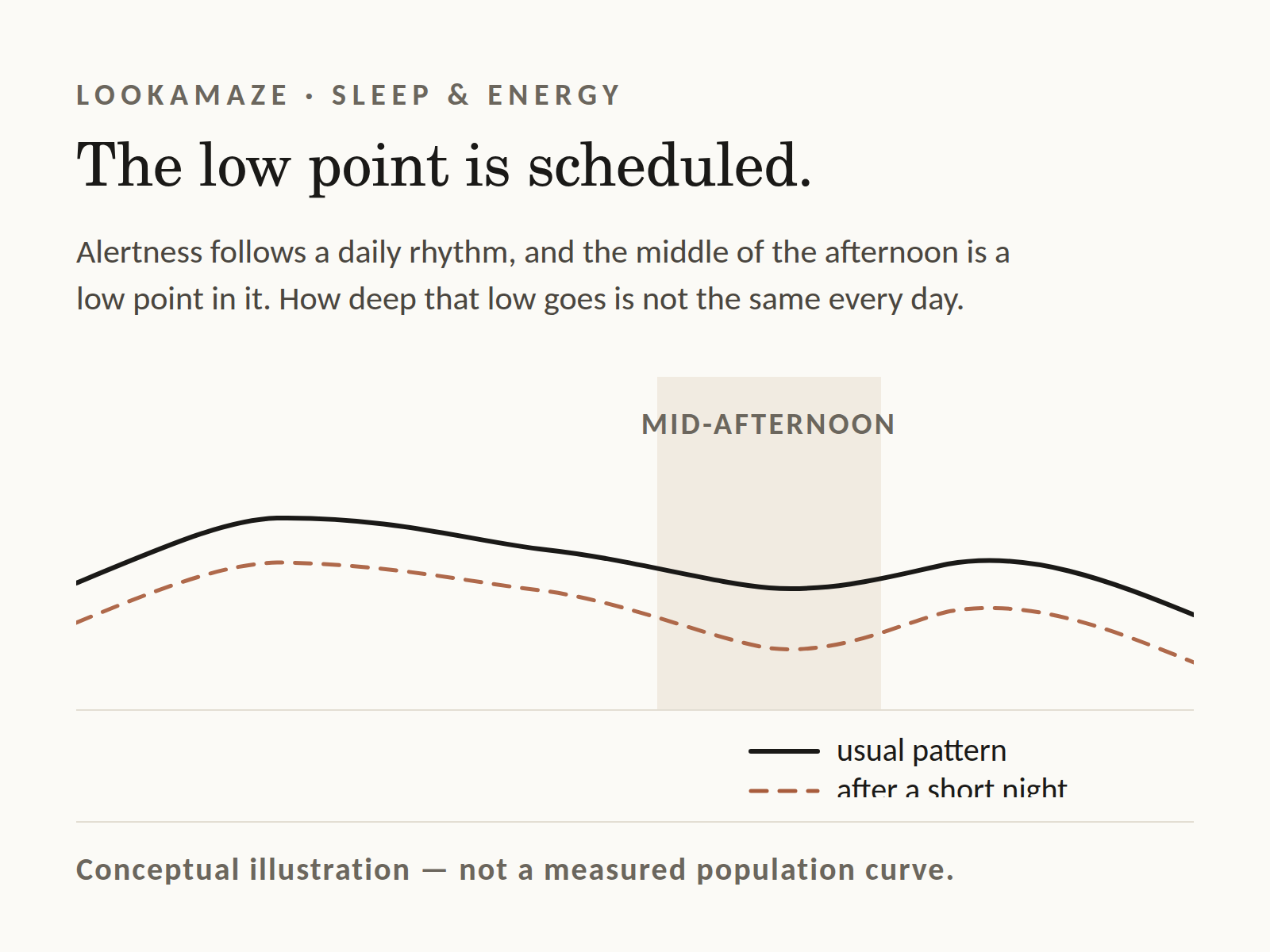
A review of the evidence in Clinics in Sports Medicine is direct about it. The mid-afternoon dip in performance “is a real phenomenon that can occur even when the individual has had no lunch and is unaware of the time of day.”¹ Its roots are in human biology.
The CDC’s occupational-health training describes the same window from the other end: at that point in the day, the circadian rhythms that promote wakefulness dip, while sleep pressure has been building since you woke, and the pressure to sleep briefly gets the upper hand.²
So two things are true at once. Your body clock has a low point in the afternoon, and by then you have been awake long enough that the drive to sleep is substantial.
Lunch still matters, just not as the cause. The same review notes the dip is “certainly exacerbated by a high-carbohydrate lunch.”¹ A heavy lunch deepens a trough that was coming anyway. It doesn’t create it.
The same afternoon, three different problems
A dip being normal does not mean your dip is normal, and it does not mean the feeling is always the same feeling.
Three things wear the same face in the afternoon.
A dip has a shape. It arrives at roughly the same time, it has a depth, and it lifts. You can push through a dull meeting, badly, because you have to.
Sleepiness is not necessarily confined to the afternoon. Its clinical definition is sleep propensity, which means the inclination to fall asleep.³ It tends to appear when you sit still, or when you get an opportunity to fall asleep, and it may not arrive at the same time every day.
Fatigue is tied to effort. It is described as extreme tiredness with reduced functioning, and it eases when the demand is removed or you rest. Sleepiness responds to more or better sleep; fatigue often doesn’t.³
Two questions help here, and neither is a test.
The first is the one you can only answer honestly: if you sat down somewhere quiet right now, with nothing to do, would you drift off? A yes is a clue, not a diagnosis. It settles nothing on its own, because several short nights produce exactly the same answer. But if it is a clear yes, the ordinary-dip advice below is probably not the advice you need.
The second is about the clock. Does your low point arrive at a similar time each day? A dip tends to be time-locked; sleepiness is less predictable. That is a pattern to notice, not a reading to trust.
If the pattern points at sleepiness, most of this page is aimed at the wrong problem, and the last section is the one that matters.
Coffee is a loan
Caffeine works by blocking adenosine, the chemical that builds up through the day and tells your brain it’s time to rest. Blocking it stops you feeling sleepy. The body adapts, though: “If you regularly consume caffeine, your body produces more adenosine. So people need more caffeine over time to get the same wakeful feeling.”⁴
That is the mechanism behind the afternoon coffee problem. Your three o’clock cup doesn’t fail because you bought the wrong coffee. Part of the reason today’s cup may feel less effective is that you use caffeine regularly.
Caffeine also stays active longer than the lift suggests. It peaks in your blood within about an hour, and you may keep feeling it for four to six hours.⁵ A cup at three may still be affecting you around nine, which is roughly when it can start working against your sleep instead of for your afternoon. The AASM’s sleep guidance is unusually plain: avoid caffeine in the afternoon or evening.⁶
Stopping suddenly has its own cost. Remove the caffeine and the extra adenosine is left unblocked, producing “headaches and increased sleepiness.”⁴
None of this makes coffee the villain. Caffeine genuinely reduces attention lapses when you are short on sleep. It just doesn’t fix everything that sleep loss disrupts. In a study of 276 undergraduates aged 18 to 26, participants either slept at home or were kept awake all night, and people in each group were then given caffeine or a placebo. Caffeine removed the sleep-deprived group’s deficit in vigilant attention, the kind of attention that keeps you noticing and reacting, but for most of them it did not significantly improve placekeeping, the ability to hold your place through a procedure. The authors conclude it has “limited potential to reduce procedural error rates in occupational settings.”⁷ It buys alertness. It doesn’t replace the night.
Which gives the one rule worth keeping:
Caffeine is a loan. It can give you alertness now while creating a cost for tonight’s sleep. The other options in this article don’t rely on that same trade-off.
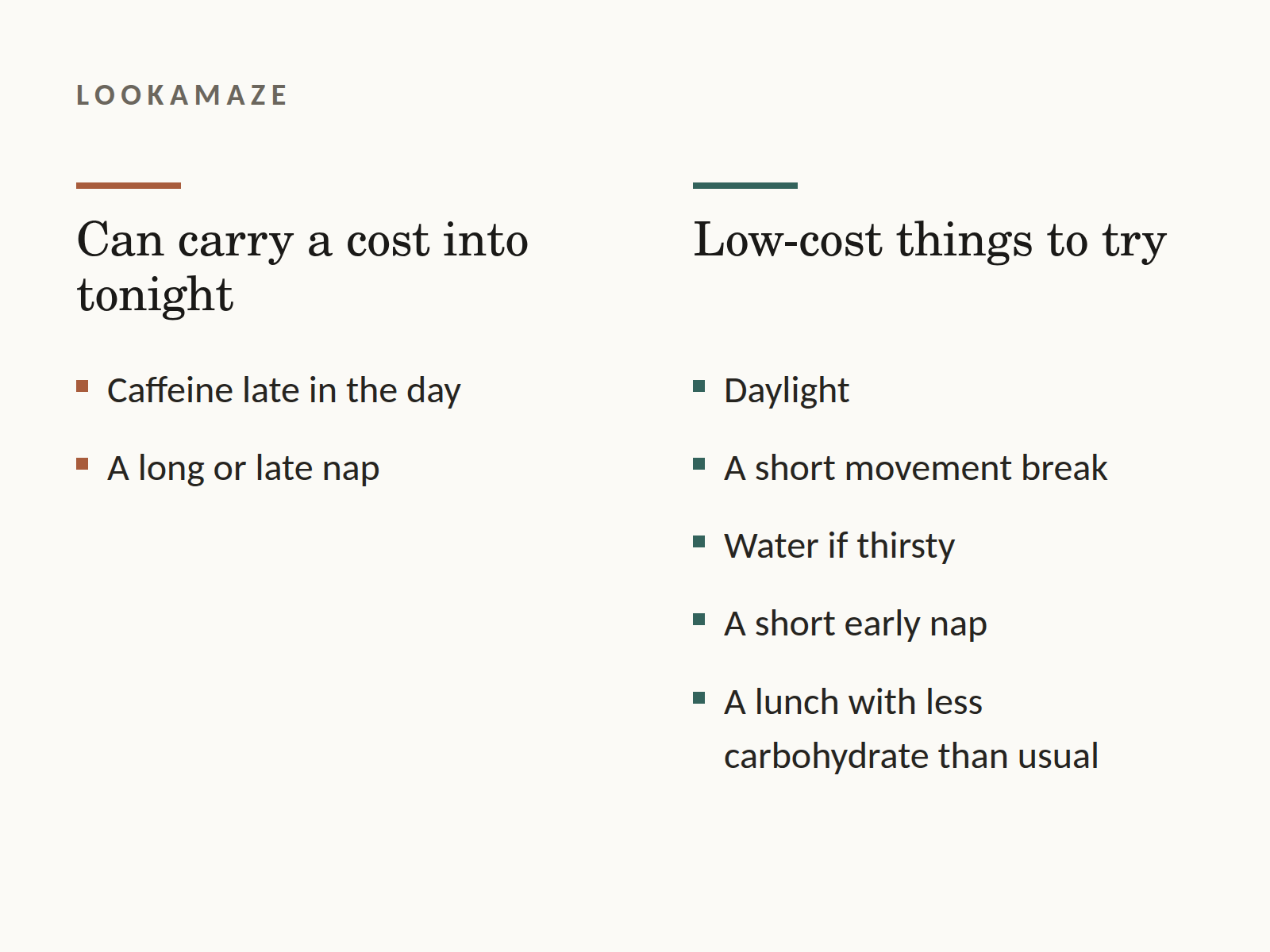
The cup isn’t the problem. It is simply the most dependable option available, which is how it becomes the only one you reach for. In a 2025 survey of U.S. adults by the AASM, 56% said they reach for caffeine to improve alertness, and 46% said they take a nap.⁸ Its past president draws the line where it belongs: “consistently relying on caffeine to function during the daytime is a sign that you need more sleep.”⁸
The nap, if you’re taking one
A nap can be one of the cheap options. It can also be a loan at a bad rate, and the difference is timing and length.
Mayo Clinic’s guidance: a 20- to 30-minute nap is ideal, and you shouldn’t snooze more than 30 minutes on a regular basis. Take it in the early afternoon, since napping after 3 p.m. “can make it harder for you to sleep soundly at night.” Expect to feel slow for a while afterwards. That is sleep inertia, and it usually clears within about 35 minutes.⁹
Two failure modes are worth knowing in advance. The longer you nap, the more likely you are to feel groggy afterward. And if you already struggle to fall asleep or stay asleep at night, napping can make that worse.⁹
What to actually do when it hits
Five steps, in this order. The order matters, because step four decides whether the rest of the list is relevant.
1. Get to the brightest place you can reach. Light is the body clock’s main external signal; light and dark have the biggest influence on circadian rhythms of anything in the environment.¹⁰ The evidence that it sharpens you immediately is real but modest. A systematic review of 68 studies found brighter light increased subjective alertness in a majority of them, while a substantial proportion found no significant effect.¹¹ A free nudge, not a switch.
2. Move for a few minutes. In a small study of walking breaks during prolonged sitting, every regimen except walking just one minute per hour reduced fatigue and improved mood.¹² The study was small, but a short movement break is reasonable to try.
3. Drink water if you’re thirsty, and drop the idea that it’s a fix. A reappraisal of that literature found most studies show no association between cognitive performance and mild dehydration, particularly when the stress is mild.¹³ Water is worth drinking. It is not a demonstrated afternoon lever, and anyone telling you your afternoon fog is dehydration is guessing. A low-cost option that does nothing costs the same as one that works.
4. Ask the one question. Am I sleepy, or am I tired? The quiet-room question above is the quickest way in, and if the answer is sleepy, caffeine is probably not the main answer.
5. Then decide about the cup. If it’s early and you need to be sharp now, caffeine is a reasonable trade. Later on, the same cup is more likely to be sitting in front of your sleep than helping your afternoon, and regular use makes the next cup work less well. Sometimes that trade is still worth making. It should be a decision, not a reflex.
The five-afternoon test
You cannot solve this from a list. You can learn something about your own afternoons in five of them.
This is simple self-tracking, not a research study. It won’t prove anything, and it isn’t meant to. What it can do is show you a pattern that a single bad afternoon can’t.
Afternoons 1 and 2: record, change nothing. Note four things: the time the dip started, how deep it went on a scale of 1 to 5, what you did about it, and what happened next. A note on your phone is fine.
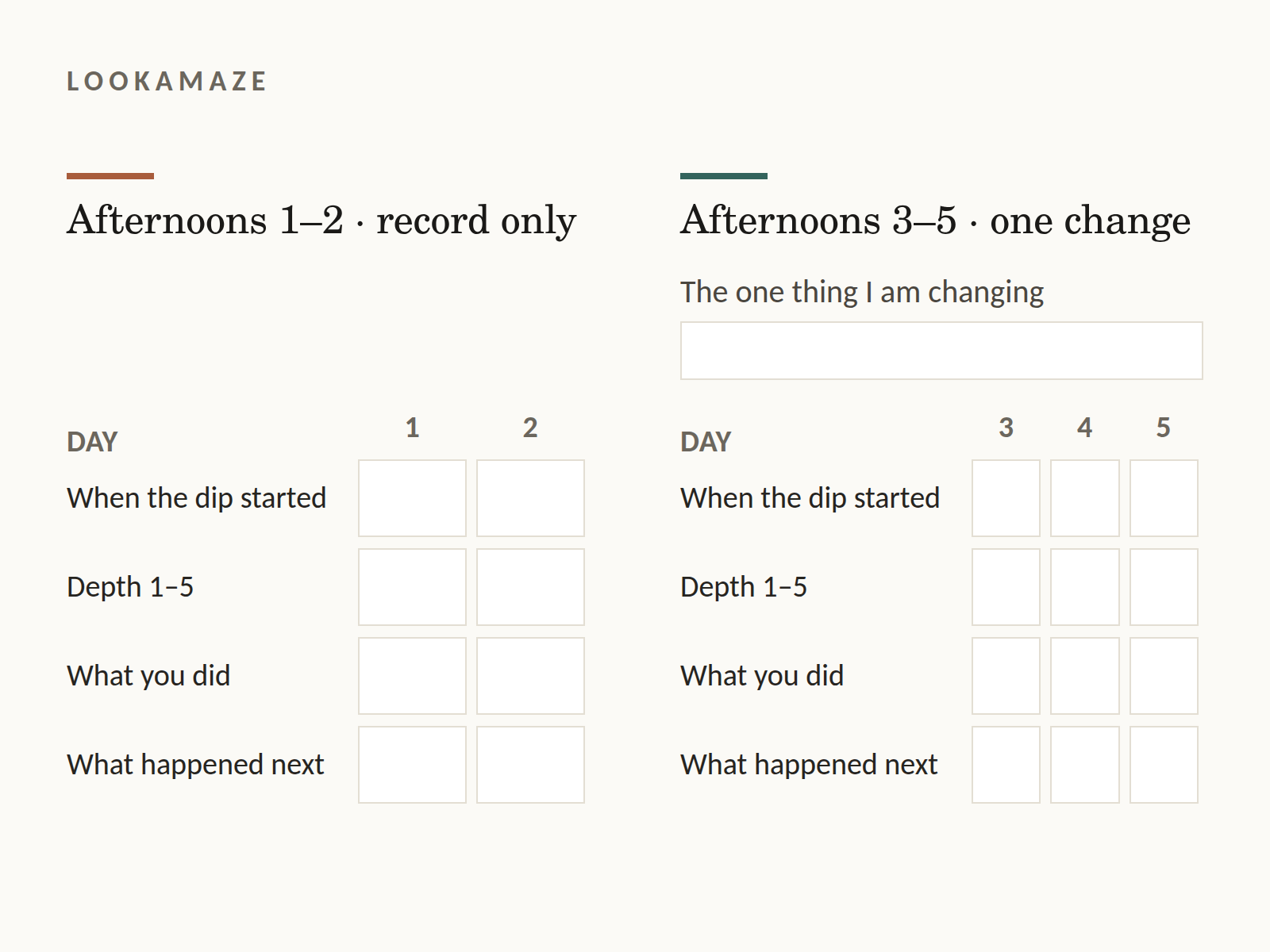
Afternoons 3, 4 and 5: change exactly one thing. Hold everything else steady. Pick one:
- a short walk when the dip starts
- getting outside into daylight
- no caffeine after a fixed hour
- a 20-minute nap before 3 p.m.
- a lunch that goes lighter on carbohydrates than your usual one, since the review above found the dip is exacerbated by a high-carbohydrate lunch¹
Then look for a pattern. Compare the three test afternoons against the two you recorded, rather than judging the result from a single day. This is the whole logic of one change at a time, and the reason the exercise works at all.
The branches, each with a next step:
- The pattern improved. That change is worth carrying forward for another week before you change anything else.
- Nothing moved. You didn’t see a useful signal, so test a different single change next week.
- It got worse. Stop and note what you did. These fixes backfire in dull, predictable ways: a nap that ran long, a cup that was later than you thought.
- The dip arrived whatever you did, or you dozed off unplanned. Stop self-tracking. Go to the last section.
One honest limit: if the change you chose is a change to your night, such as a wake time you hold, three afternoons cannot tell you anything about it. Judge that over a couple of weeks, not five afternoons.
When it isn’t the afternoon dip
The AASM’s position statement holds that sleepiness is “a critical patient-reported outcome” associated with increased risk and diminished quality of life, and that evaluating and managing it “is essential for patient safety and patient-centered care.”¹⁴ Its public framing is blunter: excessive daytime sleepiness “is a warning sign that demands clinical attention.”⁸ The same survey found that 72% of U.S. adults say sleepiness affects their daily activities.⁸ Common, in other words, is not the same as harmless.
This is not a disease list. It is a boundary, and four things put you on the other side of it:
- You are fighting to stay awake during the day, at work or on the way there.⁸
- You doze off without meaning to, or you catch yourself “nodding off” and have trouble keeping your head up.¹⁵
- Someone has told you that you snore, or that you gasp, snort or choke in your sleep. The NHS lists that next to unexplained tiredness lasting a few weeks, or tiredness that affects your daily life, as a reason to see a GP.¹⁶ That symptom is invisible from the inside. You cannot self-assess it, which is exactly why it belongs to a doctor.
- You need naps more than you used to, or you still feel sleepy after waking in the morning.⁹
And one that is not about diagnosis at all. The AASM’s drowsy-driving warning signs include catching yourself nodding off and drifting onto the rumble strip.¹⁵ Don’t run that experiment on a road.
An ordinary afternoon dip is a routine problem, and the test above is a practical place to start. Persistent daytime sleepiness is a symptom, and symptoms have causes a doctor can check.
Tomorrow afternoon
You don’t need to fix the whole day. You need one small thing you can repeat tomorrow.
If the mornings are where your day is decided, that’s a separate piece. If your nights are the part that isn’t working, start with why sufficient sleep still leaves you tired. If it’s the load you’re carrying rather than the sleep under it, that’s a different article again, and if your evenings never actually wind down, that’s where the night begins. If the room itself is the problem, that belongs to a piece still to come.
The next time your hand is on the mug in the middle of the afternoon, you’ll have one extra question available: am I buying this hour, or borrowing it from tonight?
Sources
- Monk TH. The post-lunch dip in performance. Clinics in Sports Medicine, 2005 Apr;24(2):e15–23 — abstract via PubMed, U.S. National Library of Medicine. https://pubmed.ncbi.nlm.nih.gov/15892914/
- NIOSH Training for Nurses on Shift Work and Long Work Hours — “Afternoon Dip in Wakefulness.” Centers for Disease Control and Prevention (CDC/NIOSH). https://www.cdc.gov/niosh/work-hour-training-for-nurses/longhours/mod2/21.html
- Barham M, Bauerle T, Eiter B. Are Fatigue and Sleepiness the Same? A Brief Introduction to the Differences and Similarities and Their Implications for Work Safety. Mining, Metallurgy & Exploration, 41 (2023) — CDC/NIOSH authors, full text via PubMed Central. https://pmc.ncbi.nlm.nih.gov/articles/PMC11440622/
- Tired or Wired? Caffeine and Your Brain. NIH News in Health, National Institutes of Health. https://newsinhealth.nih.gov/2020/10/tired-or-wired
- Caffeine. MedlinePlus, U.S. National Library of Medicine (NIH). https://medlineplus.gov/caffeine.html
- Healthy Sleep Habits. American Academy of Sleep Medicine (Sleep Education). https://sleepeducation.org/healthy-sleep/healthy-sleep-habits/
- Stepan ME, Altmann EM, Fenn KM. Caffeine selectively mitigates cognitive deficits caused by sleep deprivation. Journal of Experimental Psychology: Learning, Memory, and Cognition, 47 (2021) — full text via PubMed Central. https://pmc.ncbi.nlm.nih.gov/articles/PMC12884582/
- Daytime sleepiness affects daily activities of most adults (2025 AASM Sleep Prioritization Survey, U.S. adults). American Academy of Sleep Medicine. https://aasm.org/daytime-sleepiness-affects-daily-activities-of-most-adults/
- Napping: Do’s and don’ts for healthy adults. Mayo Clinic. https://www.mayoclinic.org/healthy-lifestyle/adult-health/in-depth/napping/art-20048319
- Circadian Rhythms (fact sheet). National Institute of General Medical Sciences, NIH. https://www.nigms.nih.gov/education/fact-sheets/Pages/circadian-rhythms
- Acute alerting effects of light: a systematic literature review. Behavioural Brain Research, 337:228–239 (2018) — record via Tilburg University research portal. https://research.tilburguniversity.edu/en/publications/acute-alerting-effects-of-light-a-systematic-literature-review
- Short walks every half hour may offset harms of too much sitting. Harvard Health Publishing (reporting a study published in Medicine & Science in Sports & Exercise, 2023). https://www.health.harvard.edu/heart-health/short-walks-every-half-hour-may-offset-harms-of-too-much-sitting
- Hydration and cognitive performance. The Journal of Nutrition, Health & Aging (Elsevier, open access). https://www.sciencedirect.com/science/article/pii/S1279770723015506
- Heffron TM, Gurubhagavatula I, Trotti LM, et al. Clinical significance of sleepiness: an American Academy of Sleep Medicine position statement. American Academy of Sleep Medicine (2025). https://aasm.org/advocacy/position-statements/clinical-significance-of-sleepiness/
- Drowsy Driving. American Academy of Sleep Medicine (Sleep Education). https://sleepeducation.org/drowsy-driving/
- Tiredness and fatigue. National Health Service (UK). https://www.nhs.uk/conditions/tiredness-and-fatigue/