Twice a year, for a day or so, your house disagrees with itself.
Your phone has almost certainly changed on its own; most do, quietly, in the early hours. Oven clocks and some car clocks may need a manual reset.
This year the disagreement lands on Sunday 25 October in the UK and most of Europe, and a week later, on Sunday 1 November, in the US.
The hour of confusion is the part everyone notices. The part that decides how your week goes is quieter: your body keeps its own time, nobody told it, and for a few days it is working from a different clock than the one on the wall.
This is about both dates, what the research does and doesn’t show about sleep, and a short plan you can start three nights ahead.
What to do, in short
- Know your date. UK and most of Europe: Sunday 25 October 2026. US: Sunday 1 November 2026.
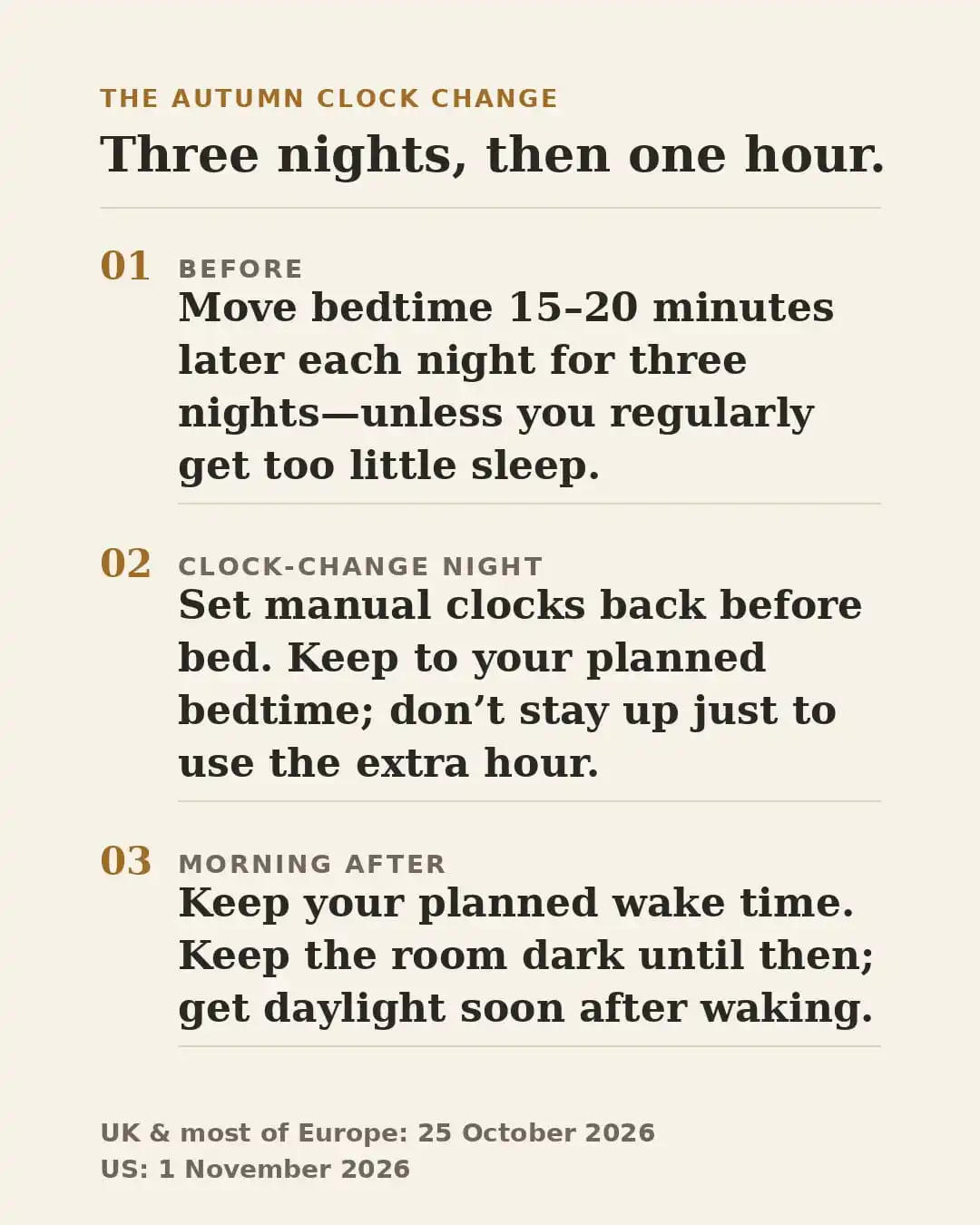
- Pick one of two plans. Sleeping well already? Move bedtime 15–20 minutes later for the three nights before. Regularly getting too little? Change nothing, and take the hour as sleep.
- Protect your wake time. Sunday morning is not the morning to lie in.
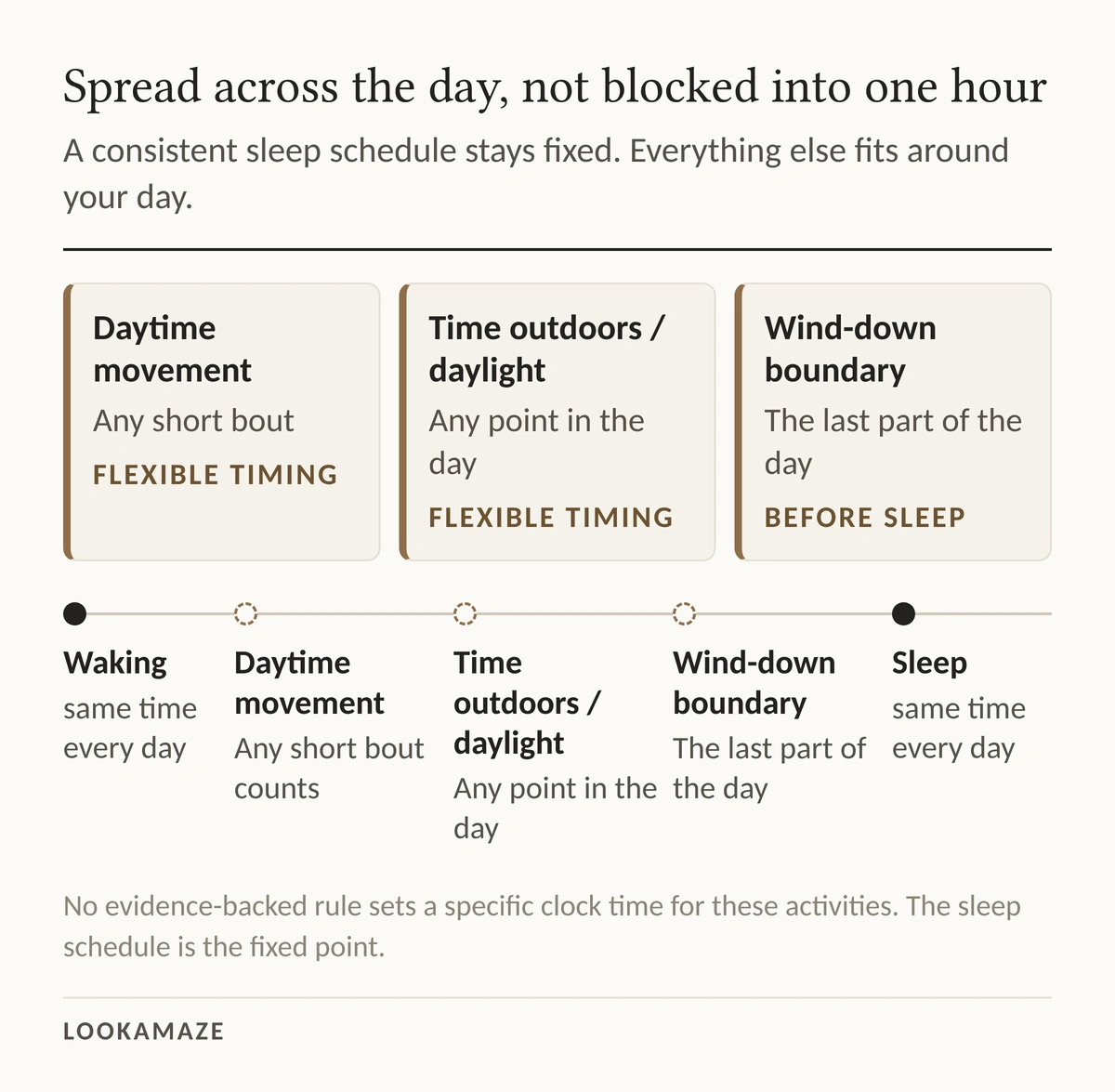
- Keep the room dark until your wake time, then get daylight. Light is the signal your body clock actually reads.
That’s the practical answer in four lines. The rest explains why each one works, and where the evidence is thinner than the usual advice implies. If you only want the plan, skip to it.
First, the two dates
The UK and the US are a week apart this year. Mainland Europe changes on the UK’s date, but not at the same hour on the clock — which is why advice written for one country can be quietly wrong in another.
- UK — Sunday 25 October 2026, at 2am local time. gov.uk states the change happens at “2am on the last Sunday in October”.
- Mainland Europe — the same Sunday, at a different local hour. Where countries observe the change, EU summer time ends at 01:00 GMT (Directive 2000/84/EC, Article 3). That is 2am in the UK, Ireland and mainland Portugal, 3am in central European countries such as France, Germany, Italy and Spain, 4am in Finland, the Baltic states and Greece, and 1am in the Azores, whose clocks run an hour behind the Portuguese mainland. Not every European country takes part — Iceland, Belarus, Russia and Turkey keep the same time all year — but wherever the change does happen, the clock goes back one hour.
- US — Sunday 1 November 2026, at 2am local time. American daylight saving ends on the first Sunday in November, a rule that comes from the Uniform Time Act of 1966 and later federal law, as the American Academy of Sleep Medicine sets out.
Not everywhere takes part. Within the US, American Samoa, most of Arizona, Guam, Hawaii, the Northern Mariana Islands, Puerto Rico and the Virgin Islands don’t observe the change, so none of this applies to them.
The plan, at a glance
Why one hour is enough to notice
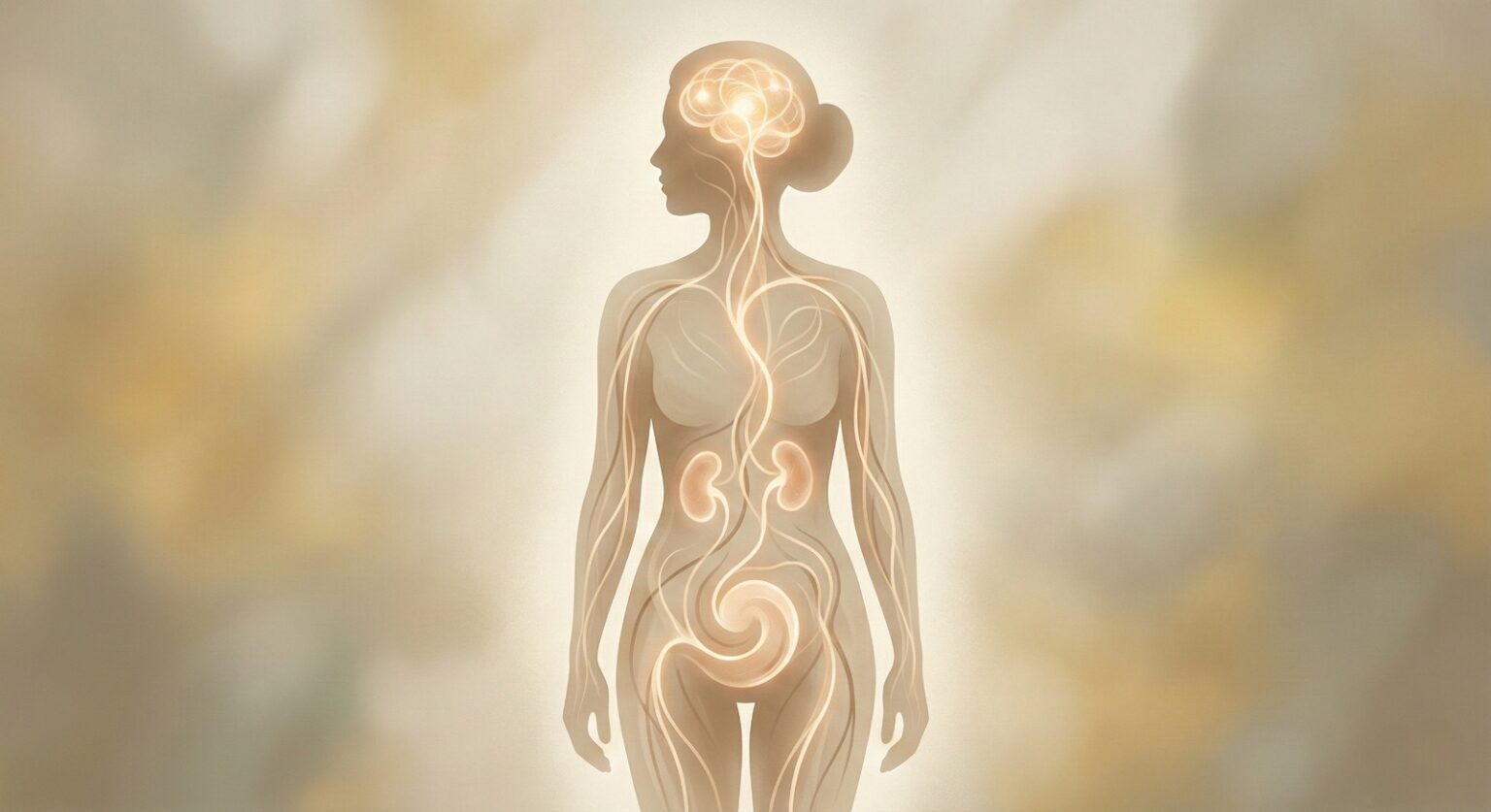
“Body clock” sounds like a figure of speech. It isn’t. There is a small group of cells in your brain that keeps roughly 24-hour time, and it sets when you feel alert and when you feel sleepy. It takes its cues mostly from light: brightness in the morning pulls you earlier, darkness in the evening holds you there.
A clock change doesn’t move the sun. So for a few days, the clock on the wall and the clock in your head are an hour apart, and your body behaves as though nothing happened.
This is why the change isn’t quite jet lag, even though it feels similar. With jet lag you fly somewhere, and the local sun eventually pulls your body clock into line. With a clock change the clock moves relative to the sun rather than the other way round: as the AASM puts it, “the local clock time changes, but the timing of sunrise and sunset remains the same” (AASM). Light exposure and daily routine are still the cues your body uses to adjust — the difference is that the new pattern has to be laid down deliberately, with morning light and a steady wake time, rather than being imposed by travel.
How long it takes varies, and it is longer than a night. Some people barely notice; others feel out of step for several days. A review of clock-change sleep studies found both transitions were associated with less sleep for about a week afterwards, and the Biobank authors note some gradual catch-up over the weekdays that followed (Harrison 2013, as summarised in the study below). Plan for days, not hours — and don’t assume you’ll feel normal by Monday.
What the research actually found
A large sleep-specific study of this question is worth reading closely, because the numbers are easy to oversimplify.
It used 11,780 UK Biobank participants aged 43–78 wearing wrist accelerometers — movement sensors that estimate sleep. The sample came from five transitions: the spring changes of 2014 and 2015, and the autumn changes of 2013, 2014 and 2015. For each one the researchers took the 15 days running from the Sunday before the change to the Sunday after, and included anyone with usable data on any of those days — 4,569 people in the spring analysis and 7,211 in the autumn. No participant had data across the whole period. Sleep was totalled over a midnight-to-midnight day, so “the Sunday of the change” means that whole calendar day, and it was compared with the Sunday before and the Sunday after (de Lange et al., Journal of Sleep Research 2025).
- Autumn: average sleep on the Sunday of the change was 33 minutes higher than the Sunday before (95% CI 27–39) and 38 minutes higher than the Sunday after (32–43).
- Spring: 65 minutes lower than the Sunday before (−72 to −58).
Four things about those figures matter more than the headline.
The day wasn’t 24 hours long. A clock-change Sunday is 25 hours in autumn and 23 in spring, so a straight daily total would overstate autumn and understate spring before anyone had behaved differently. The researchers adjusted their calculation for this rather than comparing a 25-hour day with a 24-hour day as though the two were the same. The +33 minutes is therefore an adjusted figure, not simply the extra hour turning up in the sum.
They are group averages, not your night. The study compared different participants on those days rather than tracking the same person night by night, and not everyone had data for every night. So it does not mean the autumn night was exactly 33 minutes longer, or that any individual gained that much. It means the group average was higher.
It measured sleep duration, not how anyone felt. Movement was recorded; mood, alertness and wellbeing were not. The study can tell you people slept longer. It cannot tell you most people sail through the change unaffected, because it never asked.
It didn’t establish why the full hour doesn’t arrive. The authors write that participants “did not (or could not) take advantage of the full extra hour of increased sleep”, and offer a tentative reason — that “their body clocks or social commitments prevent them from having an entire hour more sleep” — while leaving it open. An earlier review had attributed autumn sleep loss to people continuing to wake early, which is a reasonable explanation and the one most articles repeat; it is just not something this study tested. Treat it as a likely contributor, not a settled mechanism.
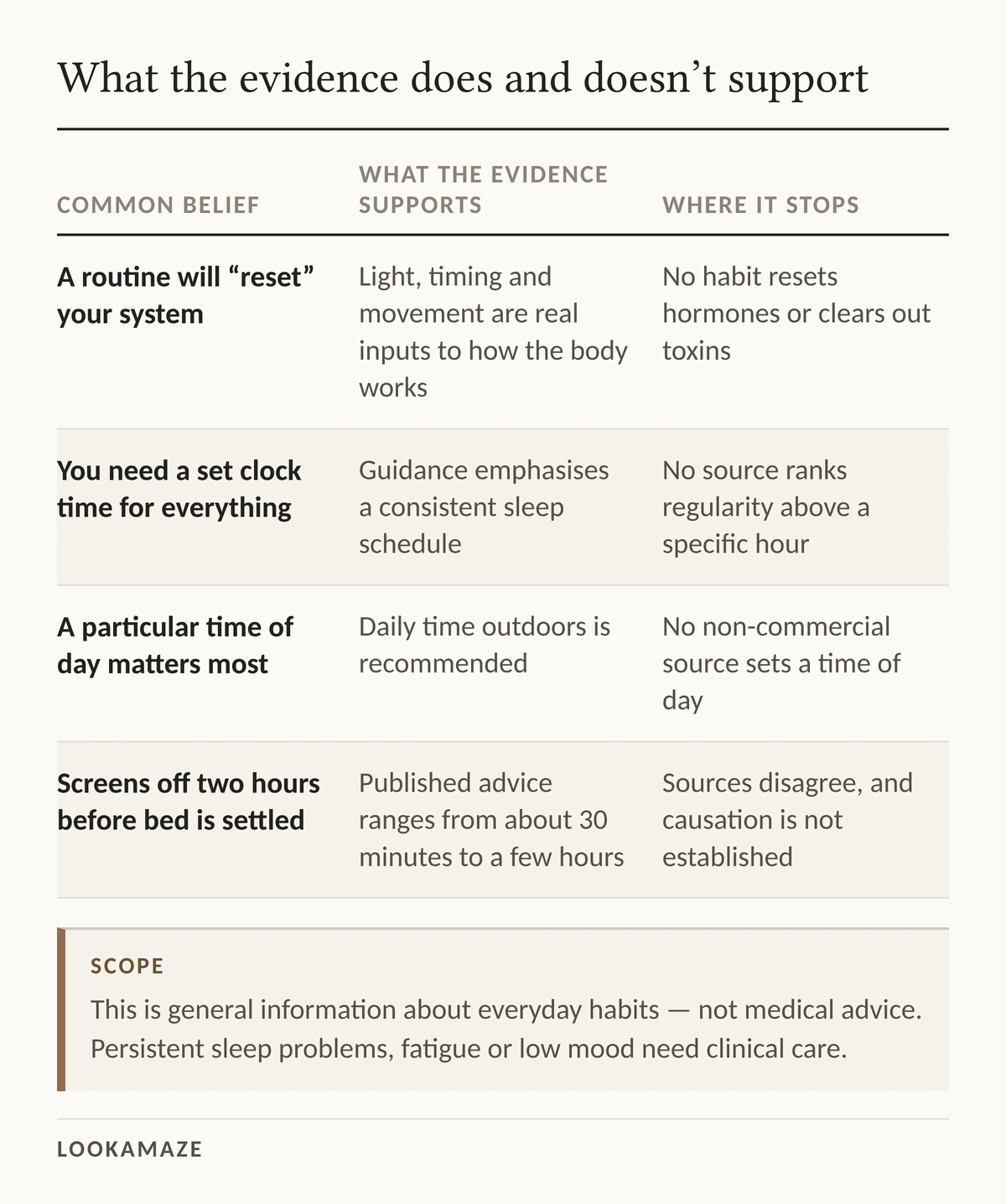
One more attribution to keep straight: the pattern most often quoted — that the spring change hits evening types and short sleepers hardest, while morning types and long sleepers lose most in autumn — comes from earlier work (Harrison 2013; Kantermann et al. 2007; Lahti et al. 2006, 2008; Tyler 2021), summarised in this paper’s introduction rather than measured in its participants. It’s a pattern in the literature, not a prediction about you.
What the evidence does support, and what it’s worth acting on:
- Spring is the harder change. The clearer health and road-safety signals sit with the transition into daylight saving, when an hour is lost.
- Autumn is gentler on sleep duration. The population average rises rather than falls.
- If you already sleep badly, either change may be more disruptive. The AASM notes the transitions “can be especially problematic for any populations that already experience chronic insufficient sleep or other sleep difficulties”, naming teenagers and night shift workers among those at greatest risk.
One hour, then — enough to notice, and for some people enough to unsettle several days. What follows matters more than the hour itself: what happens to the light afterwards.
The part people miss: the light keeps changing
The clocks move once. The daylight doesn’t stop moving for weeks.
Through November and December the sunsets come earlier whatever the clock says, and the mornings get thinner. So the thing that shifts sleep timing through winter isn’t the single night in October. It’s the slow slide either side of it — and the awkward fact that morning light is scarcest exactly when it would help most.
Light isn’t a nice-to-have here. As the AASM puts it, “light and darkness are the most powerful timing cues for alertness and sleepiness in the human body.” Which makes the most useful habit of the darker half of the year also the least exciting one: get daylight soon after you wake. If you build one thing into a winter morning, build that — see morning habits that set the tone for the day.
Two ways to handle the three nights before
Here the official guidance is specific, and it splits in a way most summaries leave out.
The AASM’s transition sleep tips advise shifting your bedtime 15 to 20 minutes later each night over the few nights before the autumn change, so that the new clock time feels normal by Sunday.
The same page then makes an exception, and it is worth quoting exactly, because it reverses the plan for a lot of people:
“If you are experiencing chronic insufficient sleep, you should avoid shifting your bedtime later before the fall time change; you will benefit from getting an ‘extra’ hour of sleep on the night when you ‘fall back’ to standard time.”
So there are two legitimate plans, and the right one depends on how rested you already are:
| If you… | Do this for the three nights before |
|---|---|
| Sleep well most nights | Shift bedtime 15–20 minutes later each night, so the new clock time feels normal by Sunday. |
| Are regularly getting too little sleep | Change nothing. Go to bed at your planned time and let the extra hour be sleep, not a bonus hour of evening. |
Either way, three small things help:
- Move your mealtimes with your bedtime. The AASM advises adjusting the routines that act as time cues, meals included, to match the new schedule before the change.
- Get the sleep you actually need. Adults should aim for seven or more hours a night; teenagers need 8–10 hours (AASM consensus recommendations). This is the factor most likely to decide how the change feels.
- Reset the manual clocks on Saturday evening, then go to bed as planned. Doing it early removes the temptation to spend the “extra” hour staying up.
The morning after
Four things matter more than the rest.
- Keep the room dark until your planned wake time. For the autumn change the AASM advises that you “minimize light exposure until your target morning wake time.” This is the counter-intuitive one: the early light that helps you adjust in spring can wake you earlier than you want in autumn, particularly if your curtains are thin.
- Then get bright light, fairly soon after you’re up. Daylight in the first part of the morning is one of the strongest signals available for shifting your body clock onto the new time, and it is the habit worth protecting if you have a morning routine at all.
- Try not to sleep in to “use” the hour. A long lie-in tends to push your body clock later, which can make Monday harder — not guaranteed, but common enough that it’s worth avoiding on the Sunday.
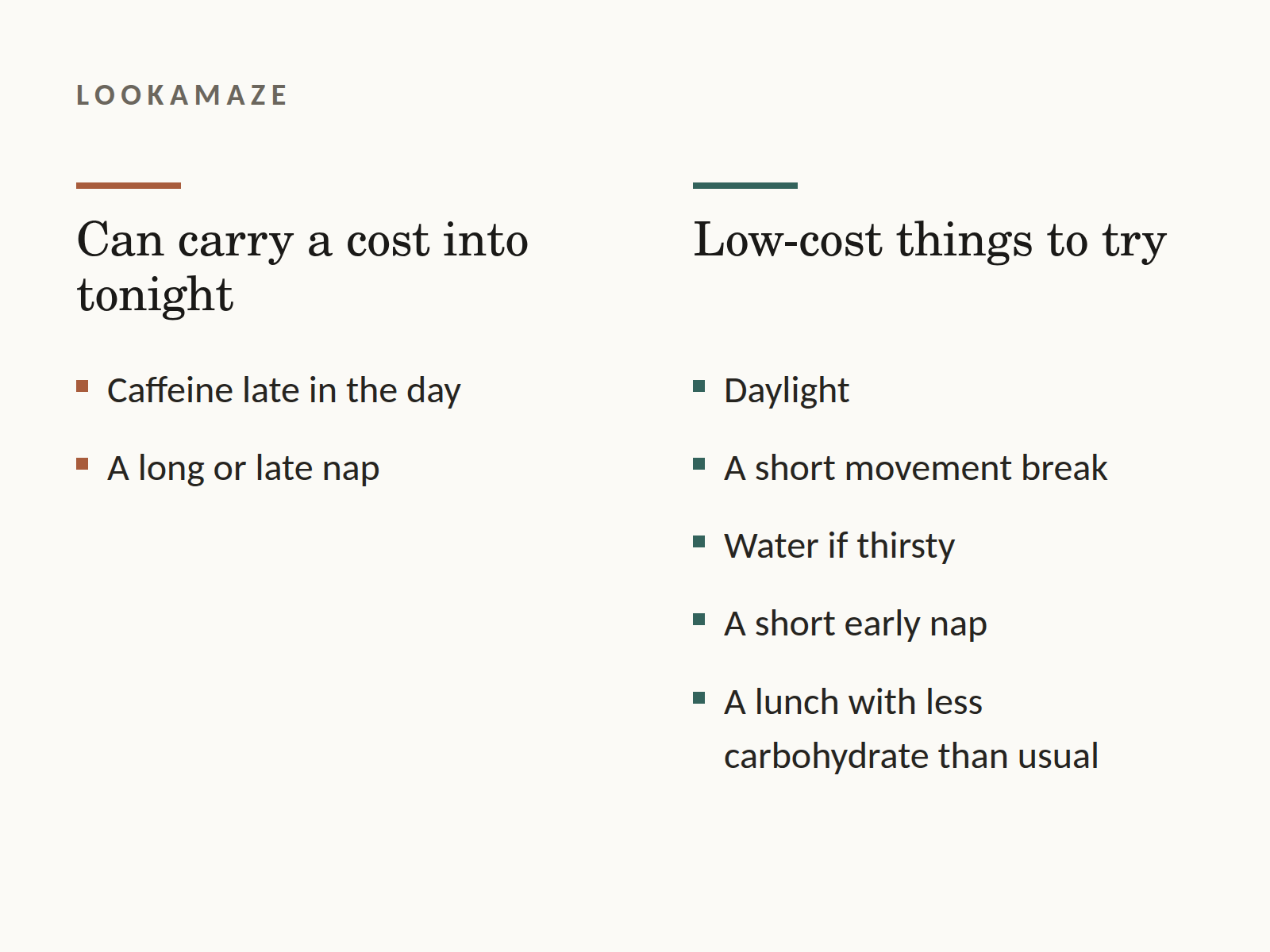
- Watch when you drink coffee. An earlier sunset shifts when you feel tired, so a late-afternoon coffee may land differently than it did last week. If you’re leaning on caffeine to get through the shift, earlier is the better trade — the afternoon slump has more on why.
And keep the evenings simple. This isn’t the week to rebuild your wind-down; a short, repeatable one survives a disrupted week far better than an ambitious one.
The mood question, briefly
Autumn also attracts a lot of claims about mental health, and here the research genuinely points in two directions. The disagreement is worth two minutes, because it is more useful than either headline.
One study found more. An analysis of nationwide psychiatric hospital data in Denmark reported an 11% rise in the incidence rate of unipolar depression after the autumn change (Hansen et al., Epidemiology 2017).
A much larger one found less. Using fifteen years of English GP and hospital records covering 683,809 people between 2008 and 2019, researchers compared the week after each clock change with a control period. In the week after the autumn change they found fewer recorded events: depression at a rate ratio of 0.96, sleep disorders at 0.92, and similar small reductions for anxiety and psychiatric conditions generally. A rate ratio below 1 means fewer events than the comparison period, not more. They found little evidence of any change after the spring change (de Lange et al., BMJ 2025).
The two results sit more comfortably together than they first appear, because they are not measuring the same thing:
- Different populations. One covers people who reached specialist psychiatric hospitals in Denmark. The other covers a general English population in ordinary GP and hospital care.
- Different outcomes. One measures the incidence rate of unipolar depression in psychiatric settings. The other counts recorded depression events — diagnoses and prescriptions in clinical notes.
- Different observation windows — and the English study is explicit that a record’s date is when a clinician entered it, which “is not necessarily the date of symptom onset.”
Neither result tells you what will happen to you. Population event rates can’t predict whether you personally will feel low in November, and neither study is a reason to expect a mood change because the clocks moved — or to dismiss one if it comes.
What is worth acting on doesn’t depend on settling that argument. If a low mood keeps returning at the same point in the year, that’s worth raising rather than waiting out: the NHS considers seasonal affective disorder where depression symptoms have recurred at that time of year for two years or longer (NHS).
If you already sleep badly
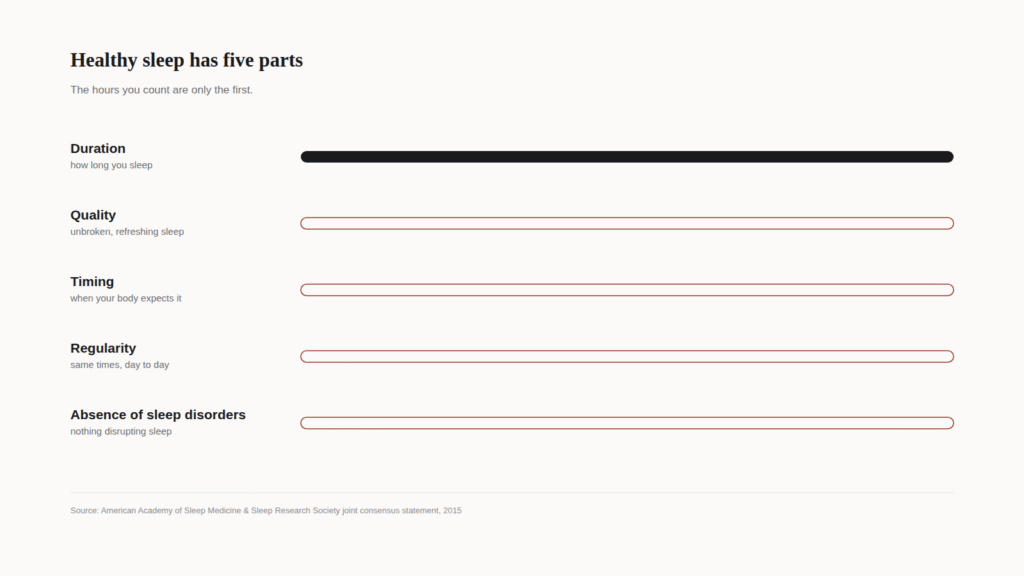
If you wake tired most days, the clock change is probably not your problem. It just makes the existing one harder to ignore.
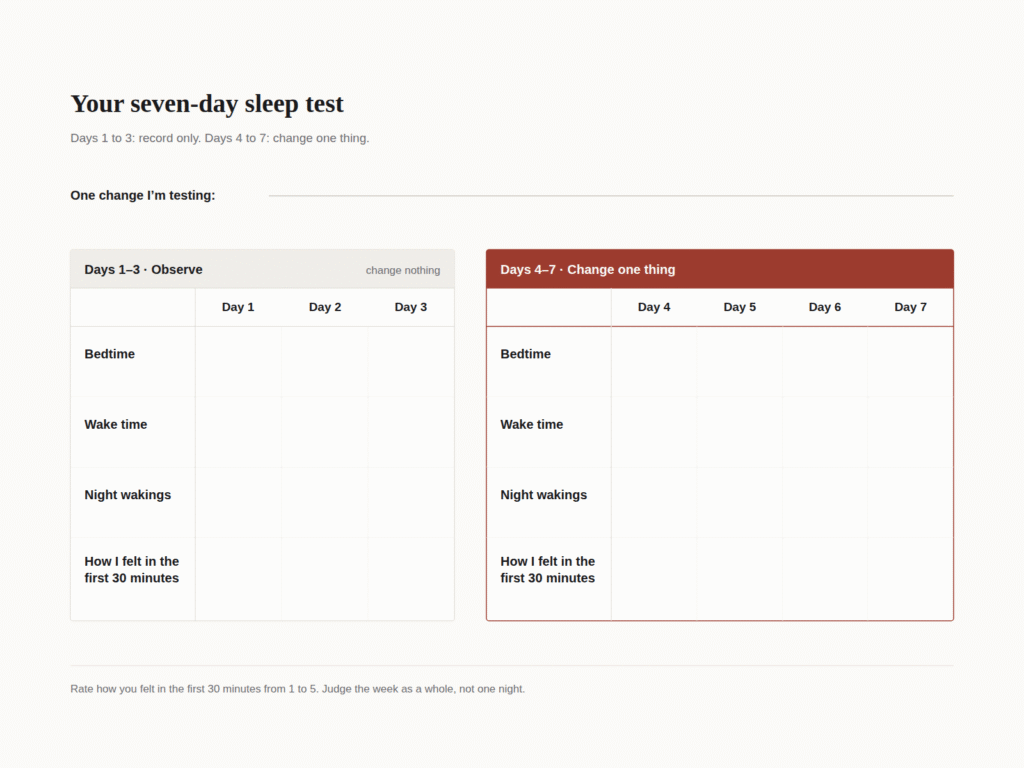
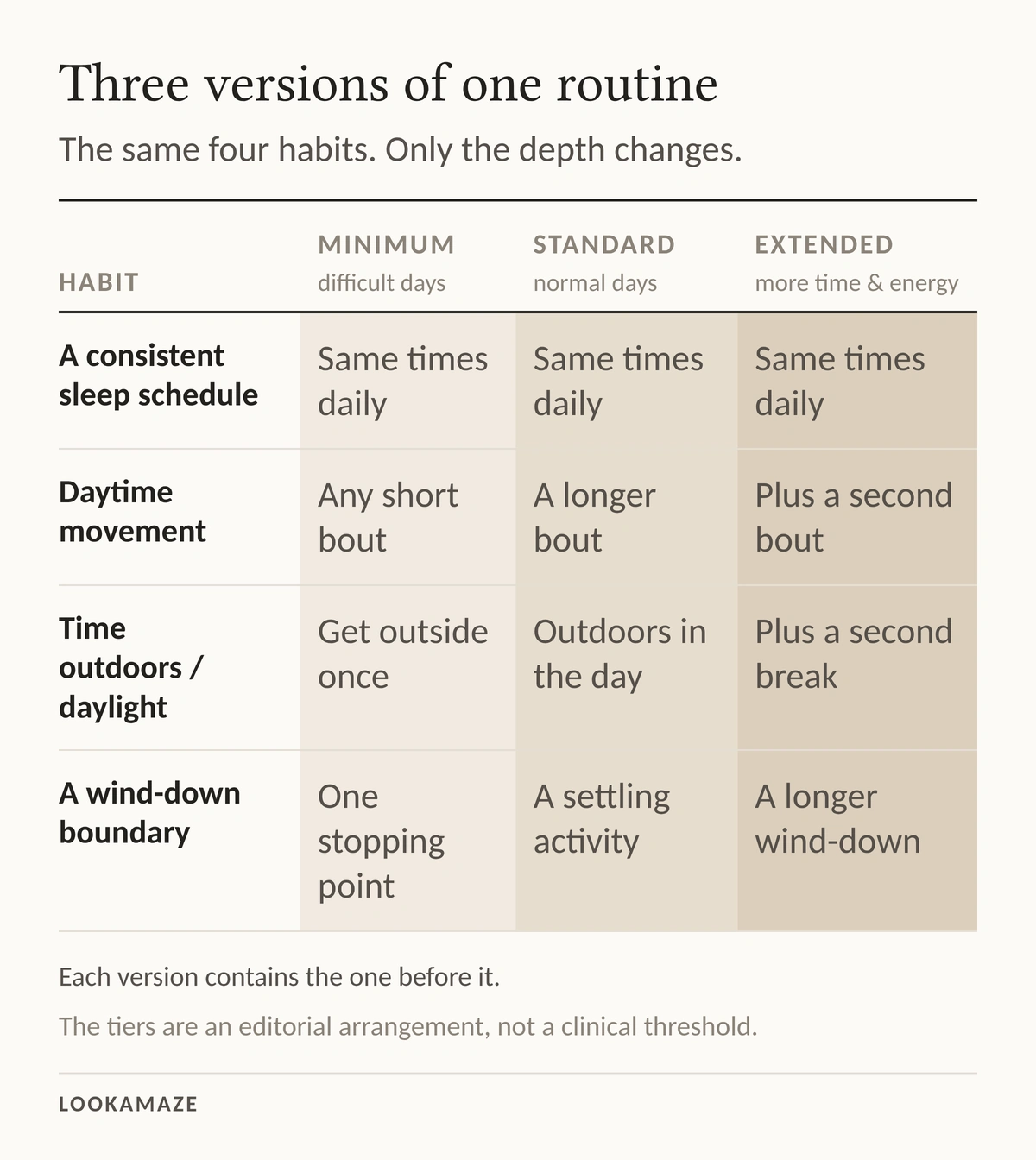
Two other pieces are a better use of your time than this one: a seven-day test for “why am I still tired after eight hours”, and the minimum version of a daily routine for weeks when a full one is unrealistic.
When to talk to a doctor
Routine changes are the wrong tool for some things. The list below is practical general advice, not a set of findings from the studies discussed above — the sleep-apnoea signs follow NHS guidance on sleep apnoea, and the mood point follows NHS guidance on seasonal affective disorder. Worth raising with a clinician rather than managing alone:
- waking unrefreshed most days for several weeks;
- loud snoring, breathing that stops and starts, or gasping, snorting or choking noises while you sleep — the main symptoms of sleep apnoea, which the NHS advises taking to a GP;
- daytime sleepiness that affects driving or safety — the NHS notes that confirmed sleep apnoea with excessive sleepiness has implications for driving;
- a low mood that returns each year at the same time, or that outlasts the season.
What this piece is not
This is general information about a predictable annual event — not medical advice, diagnosis or a treatment plan. If you have a sleep disorder, a heart condition, or take medication that affects sleep or alertness, treat the plan above as something to discuss with a clinician who knows your situation, not something to apply on your own.
The clocks change on a Sunday. What you do over the three nights before it, and on the mornings after, is what decides much of how that week feels. Start with the wake time, add daylight, and leave the rest alone.
Sources
- gov.uk — When do the clocks change (retrieved 17 October 2026). Confirms the UK change at 2am on the last Sunday in October. https://www.gov.uk/when-do-the-clocks-change
- Directive 2000/84/EC on summer-time arrangements, Article 3 (Official Journal L 31, 2 February 2001). Establishes that summer time ends at 01:00 GMT on the last Sunday in October in every EU member state — the basis for the differing local change times given here. https://eur-lex.europa.eu/legal-content/EN/TXT/?uri=CELEX:32000L0084
- American Academy of Sleep Medicine — SleepEducation, “Daylight Saving Time” (page dated 3 June 2025; retrieved 17 October 2026). Source of the US date rule and the states and territories that do not observe it; the transition sleep tips, including the autumn-specific advice and the chronic-insufficient-sleep exception quoted here; the light-and-darkness timing-cue statement; the daylight-saving-versus-jet-lag distinction; and the populations at greatest risk. https://sleepeducation.org/resources/daylight-saving-time/
- American Academy of Sleep Medicine — “AASM provides expert advice to prevent negative effects of change to Daylight Saving Time” (25 February 2019; retrieved 17 October 2026). Spring-specific advice. Source of the AASM health advisory wording and the observation that “those who regularly get insufficient sleep may experience the most adverse effects of the time change”. https://aasm.org/daylight-saving-time-advice/
- Paruthi S, et al. Recommended amount of sleep for pediatric populations: a consensus statement of the American Academy of Sleep Medicine. Journal of Clinical Sleep Medicine 2016;12(6):785–786. Source of the 8–10 hours for teenagers recommendation. https://pmc.ncbi.nlm.nih.gov/articles/PMC5078711/
- American Academy of Sleep Medicine — “Seven or more hours of sleep per night: a health necessity for adults” (updated 30 July 2024; retrieved 17 October 2026). Source of the seven or more hours adult recommendation. https://aasm.org/seven-or-more-hours-of-sleep-per-night-a-health-necessity-for-adults/
- de Lange MA, Birnie K, Richmond RC, Shapland CY, Eastwood SV, Tilling K, Davies NM. Acute effects of daylight saving time clock changes on mental and physical health in England: population based retrospective cohort study. BMJ 2025;391:e085962. doi:10.1136/bmj-2025-085962 (published 17 December 2025). Source of the 683,809-person cohort, the recorded-event rate ratios for the week after the autumn change, and the caveat that a record’s date is not the date of symptom onset. https://www.bmj.com/content/391/bmj-2025-085962
- Hansen BT, Sønderskov KM, Hageman I, Dinesen PT, Østergaard SD. Daylight savings time transitions and the incidence rate of unipolar depressive episodes. Epidemiology 2017;28(3):346–353. doi:10.1097/EDE.0000000000000580. Source of the 11% figure for the Danish autumn transition. https://doi.org/10.1097/EDE.0000000000000580
- de Lange MA, Richmond RC, Birnie K, Shapland CY, Tilling K, Davies NM. The effects of daylight saving time clock changes on accelerometer-measured sleep duration in the UK Biobank. Journal of Sleep Research 2025;34(3):e14335. doi:10.1111/jsr.14335. Source of the participant count and ages, the five transitions covered (spring 2014 and 2015; autumn 2013, 2014 and 2015), the 15-day window from the Sunday before to the Sunday after, the one-or-more-days sampling with no participant present across the whole period, the spring and autumn subgroup sizes (4,569 and 7,211), the midnight-to-midnight daily window, the 23/25-hour adjustment, the between-individual comparison, the +33 / +38 / −65 minute figures with confidence intervals, the authors’ statement that participants did not or could not take the full extra hour and their tentative explanation, and the summary of Harrison (2013) and the chronotype literature. https://pmc.ncbi.nlm.nih.gov/articles/PMC12069741/
- NHS — Seasonal affective disorder (SAD) (retrieved 17 October 2026). Source of the two-year recurrence context. https://www.nhs.uk/mental-health/conditions/seasonal-affective-disorder-sad/
- NHS — Sleep apnoea (page last reviewed 11 May 2026; retrieved 17 October 2026). Source of the warning signs listed in “When to talk to a doctor” — breathing that stops and starts, gasping/snorting/choking noises, loud snoring, waking frequently — and of the note that confirmed sleep apnoea with excessive sleepiness has implications for driving. https://www.nhs.uk/conditions/sleep-apnoea/
Notes on sourcing and scope. Claims about heart attacks, atrial fibrillation and traffic accidents are attributed by the AASM specifically to the change from standard time to daylight saving — the spring transition — and this article keeps them there rather than applying them to autumn. The two depression studies are reported with their populations, outcomes and windows stated, because the disagreement is the useful part. A doctoral thesis reporting percentage decreases in hospital presentations after the autumn change was excluded for not yet being peer-reviewed. Where the evidence for autumn specifically is thin, this article says so rather than filling the gap.