
Search for “how to boost your immune system” and you’ll find a thousand miracle foods, drinks and supplements. The honest version is less exciting and more useful: you can’t dial your immune system up like a volume knob, but you can genuinely support it.
Your immune system is a complex, finely balanced network. It needs the right support to do its job — and the evidence for that support is real: sleep, food, movement, stress management, and vaccines. This article separates what actually helps from what’s just marketing, and explains when “getting sick often” is worth a doctor’s visit.
Can You Really "Boost" Your Immune System?
Not the way most people imagine. The immune system isn’t a muscle you can pump up, and a healthy one doesn’t need “boosting” — it needs the right support to keep working normally.
That doesn’t mean healthy habits are pointless. The U.S. Centers for Disease Control and Prevention (CDC) is clear: you can strengthen your immune system by eating well, being physically active, and maintaining a healthy weight — along with getting enough sleep, not smoking, and avoiding excessive alcohol.
And the National Institutes of Health (NIH) notes that immune systems are complex networks influenced by many factors — which is exactly why “one magic pill” claims deserve suspicion. The useful question isn’t “how do I supercharge my immunity?” It’s “what genuinely supports it?” That’s what the rest of this article answers — with the evidence, not the marketing.
What Actually Supports Immune Health
A few basics are worth getting right:
- Sleep– Getting enough sleep is part of normal immune function, per the CDC.
- Regular movement- Physical activity supports overall health and may benefit immune function.
- A balanced diet- Nutrient deficiencies can impair immunity, so eating well matters.
- Managing stress- Ongoing stress can make sleep and healthy routines harder.
- Not smoking- and keeping alcohol moderate. Smoking and heavy drinking are harmful to the immune system.
- Vaccination- It trains your immune system against specific diseases (more on this below).
None of this “supercharges” anything. It supports normal function — which is exactly the honest goal.
Food and Nutrition: What Actually Matters
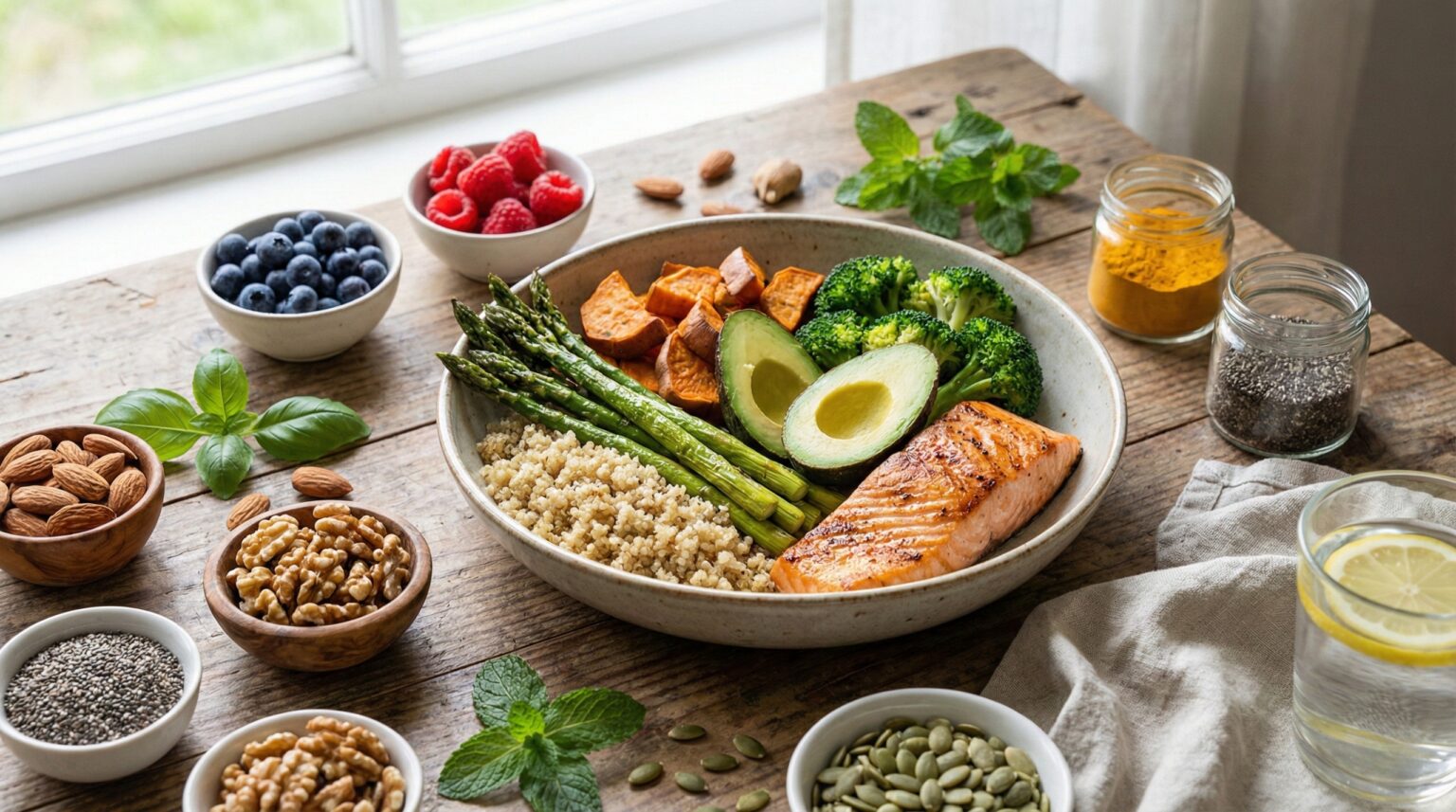
Here’s the simple version: enough matters. More isn’t automatically better.
Your immune system needs certain nutrients — like vitamin C, vitamin D, zinc, iron and selenium — to work properly. If you’re short of them, immunity can suffer. That’s about avoiding deficiency, not about eating “immune foods,” as Harvard’s Nutrition Source explains.
No single food, spice or “superfood” has been shown to boost immunity on its own. Turmeric, ginger and garlic are wonderful in food — enjoy them as flavour, not as medicine. Don’t rely on special juices, shots or individual “superfoods” as substitutes for an overall nutritious diet.
What the evidence does support is an overall nutritious diet: vegetables, fruit, whole grains, protein, and healthy fats — the same pattern that supports the rest of your health. Gut health fits in here too: the gut microbiome and immune system interact, and a varied, fibre-rich diet can support beneficial gut microbes. No magic percentage, no single miracle food — just a good diet, most of the time.
Supplements: What the Evidence Really Says
The honest headline: a nutrient being needed for immunity doesn’t mean extra amounts boost immunity in someone who already gets enough. The National Institutes of Health puts it plainly — in the absence of deficiency, routine supplementation probably does little to prevent or treat specific infections.
Here’s what the evidence actually says about the popular ones:
- Regular supplementation does not meaningfully prevent colds in the general population, per Cochrane.
- Among people who take it regularly, colds that occur may be modestly shorter.
- Starting it only after symptoms begin has not shown consistent benefit.
- High vitamin C intakes can cause stomach-related side effects such as nausea, cramps or diarrhea, according to NIH ODS.
- Low vitamin D can matter for health and immune function. Studies of supplementation for preventing respiratory infections have produced mixed results, with some evidence of greater benefit in people with low vitamin-D status, per the National Institutes of Health.
- That is not a reason for everyone to take high-dose vitamin D.
- If you’re concerned about deficiency or considering high-dose supplements, speak with a healthcare professional.
- May shorten an existing cold somewhat, but the evidence is uncertain.
- It does little or nothing for prevention, per the current Cochrane review.
- Higher zinc intakes can cause side effects, and taking too much over time can reduce copper status, per the NIH Office of Dietary Supplements. Zinc can also interact with some medicines. (No dose is prescribed here — that’s a conversation for a healthcare professional.)
- Different strains are different products; evidence for one strain doesn’t automatically apply to every probiotic, as the NIH Office of Dietary Supplements explains.
- They’re not general “immunity boosters.”
- People who are seriously ill or have weakened immunity should be especially careful with probiotics, per the NIH Office of Dietary Supplements.
- Evidence varies widely between herbal products, and results for one product cannot be applied to every herb or supplement. Herbal products should not be treated as general “immune boosters,” per the National Institutes of Health.
- Some can also interact with medicines, so check with a pharmacist or healthcare professional if you use supplements regularly.
The short version: if a deficiency is real, fixing it helps. If you’re already well-nourished, an expensive supplement is usually money better spent on food and sleep.
Sleep, Stress and Movement

These three deserve their own section because they’re the habits with real, everyday impact.
Sleep is important for normal immune function — the CDC notes that sleep loss can negatively affect the immune system. Most adults do best with seven to nine hours, per Harvard’s Nutrition Source; the exact number varies from person to person.
Movement matters too. Regular physical activity supports overall health and may benefit immune function — no need for extremes. A consistent routine you can keep up beats an intense one you quit.
Stress is worth taking seriously, but without a fake mechanism. Ongoing stress can disrupt sleep and healthy routines, and it has been associated with changes in immune function, per Harvard’s Nutrition Source. Managing it — whatever works for you: walks, breathing, talking to someone — is part of supporting your health, not a trendy add-on. If you want the full picture of how stress shows up in your body and mind, our mental-health article walks through it.
How Vaccines Fit In
accines deserve a clear place here, because they’re one of the most evidence-based ways to protect against specific diseases.
Healthy habits support general health and immune function. Vaccines train the immune system to recognize specific diseases, so it can respond quickly if it meets them — the CDC describes vaccines as building immunity against specific diseases.
These aren’t competing options. Eating well doesn’t replace a flu vaccine, and a vaccine doesn’t replace sleep. They work together: healthy habits support general health and immune function, while vaccines provide targeted protection against specific diseases.
When to See a Healthcare Professional
Getting sick occasionally is normal. But some patterns are worth a conversation with a doctor: infections that keep coming back, are unusually severe or long-lasting, are difficult to treat, or you repeatedly develop serious infections such as pneumonia. Mayo Clinic describes infections that are more frequent, longer lasting, or harder to treat as a pattern that deserves medical evaluation.
One important note: frequent infections have many explanations, and they do not automatically mean you have a “weak immune system.” Only a healthcare professional can assess that, with proper tests. If you’re worried about how often you get sick, don’t reach for more “immune boosters” — talk to a doctor.
The Bottom Line
You can’t supercharge your immune system, and no food, drink or supplement will do it for you. What you can do is genuinely support it: sleep enough, move regularly, eat well, manage stress, don’t smoke, and keep up with recommended vaccines.
Skip the miracle claims. Do the boring things that work. And if you’re getting sick in a way that doesn’t feel normal — often, severely, or without recovering — get it checked rather than guessing.
That’s the honest version of “boosting your immune system.” It’s less magical, but it’s grounded in evidence.