The alarm goes off and your first thought isn’t good morning. It’s already?
You went to bed at a sensible hour. Your phone says seven hours and forty minutes. By the numbers you did this right. By how you feel, you didn’t.
So you snooze. You get up on the third alarm. You make coffee before you’re fully awake. By mid-afternoon you’re reading the same sentence twice. By ten you’re too tired to do anything useful and not tired enough to fall asleep.
None of that is a character flaw. Sleep isn’t one thing. It’s several that can fail separately, and the hours you’re counting are only one of them. There’s also a distinction between being tired and being sleepy that decides whether the usual advice even applies, and it’s worth having before you spend a week on the wrong fix.
What the number misses
The hours you’re tracking answer one question out of five. The American Academy of Sleep Medicine and the Sleep Research Society put the recommended amount at seven hours or more a night for adults, seven to nine for most people, and note that individual need varies with genetics, behaviour, health and environment.¹
The same consensus lists what healthy sleep actually requires: “adequate duration, good quality, appropriate timing and regularity, and the absence of sleep disturbances or disorders.” Duration is item one.¹
So “did I get eight hours” leaves four questions unasked. Did the sleep happen when your body expected it? At consistent times? Without breaking up? Are you alert the next day? Those four can fail independently while the hours look perfect, which is why two people can both sleep seven and a half hours and wake up in different condition. The CDC counts “feeling sleepy or tired even after getting enough sleep” as a sign that quality is poor.²
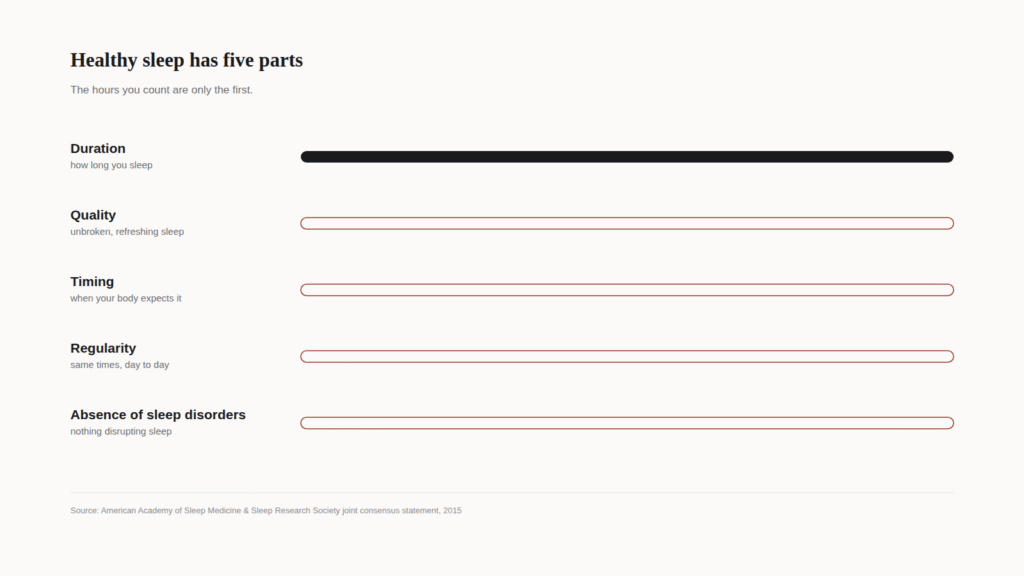
The number matched. The sleep didn’t.
One ordinary day
The times below are a composite, not your schedule.
6:40 a.m. — the alarm
The part nobody wants to hear: the time you get up is doing more work than you think.
The NHLBI is unusually specific. Same bedtime and wake time every day, weekends included, holding the weekend difference to about an hour, because staying up and sleeping in late disrupts your body clock.³
That’s what Sunday night is. You didn’t just sleep in on Saturday; you moved your body clock sideways, and Monday arrives like jet lag you gave yourself. There’s a name for it, social jetlag: the gap between your internal timing and the timing your life demands.⁴
Once a wake time holds, the rest of the morning has somewhere to sit. There’s a fuller version in these small morning habits that set the tone for the day.
7:15 a.m. — the coffee
Caffeine isn’t the problem. Caffeine at the wrong hour is. Its effects can last up to about eight hours, so an afternoon cup can make falling asleep harder.³
A 2013 trial in the Journal of Clinical Sleep Medicine puts a sharper number on it. Healthy adults took caffeine either 0, 3 or 6 hours before bed, and all three conditions cut total sleep time by roughly an hour and a quarter. Six hours before bed was still long enough.⁵
That figure comes from twelve people taking 400 mg, which is a substantial dose. Treat it as evidence that timing matters, not as a prediction of what your next cup will do.
Do the arithmetic on your own evening: asleep at 11 puts the line at about 5 p.m. Caffeine doesn’t have to keep you awake to cost you sleep. You can be unconscious all night and still lose an hour of it.
8:00 a.m. — the light
Light is the signal your body clock reads most.⁴
Light through your eyes tells your brain it’s daytime, which keeps your body clock aligned. In the evening, darkness triggers melatonin, the hormone that makes you feel sleepy. Bright artificial light late at night, from a television, a computer screen or a very bright alarm clock, can interfere with that and make falling asleep harder.⁶
So the aim is daylight reasonably early and less light reasonably late. The NHS draws the line at screens: avoid phones, tablets and computers in the hour before bed, because blue light makes it harder to fall asleep.⁷
None of this can help, though, if the thing underneath isn’t a routine problem.
2:30 p.m. — the crash
If your energy dips in the early afternoon, you’re in familiar company. What you do with it matters more than the dip itself.
More coffee walks into the six-hour problem above. A nap is the better tool, provided it’s short. Mayo Clinic’s guidance: 20 or 30 minutes, in the early afternoon, and not after 3 p.m., or it can make it harder to sleep soundly that night.⁸
Long naps carry their own penalty. That thick, heavy-headed feeling on waking has a name, sleep inertia, and it takes around 35 minutes to clear.⁸
9:30 p.m. — the wind-down
The NHLBI suggests using the hour before bed for quiet time, skipping intense exercise and bright light, and keeping heavy meals away from bedtime. Alcohol and nicotine count too.³
The NHS adds the piece that decides it for a lot of people: worrying is itself a sleep problem. If stress is what keeps you switched on, that’s worth working on rather than waiting for it to pass.
And for the nights it doesn’t work: still awake after around 20 minutes? The NHS advice is to stop trying. Get up, do something relaxing elsewhere, and go back to bed when you feel sleepy.⁷
10:45 p.m. — the bedroom
Three properties do nearly all the work: quiet, dark, cool. The NHS suggests earplugs, closed curtains, clocks out of view, your phone face down, an eye mask if light still gets through, and background sound if silence is the problem.⁷
One detail worth knowing: the NHLBI lists the light from a very bright alarm clock among the things that can interfere with melatonin.⁶ If your phone is what keeps you in the room at night, your phone and your sleep are fighting over the same hour.
The seven-day test
Everything above is a list of possibilities. This is how you find out which one is yours.
Change five things at once, feel better, and you’ve learned nothing. You won’t know what worked, and you’ll probably drop all five within a fortnight. So: one change, one week.
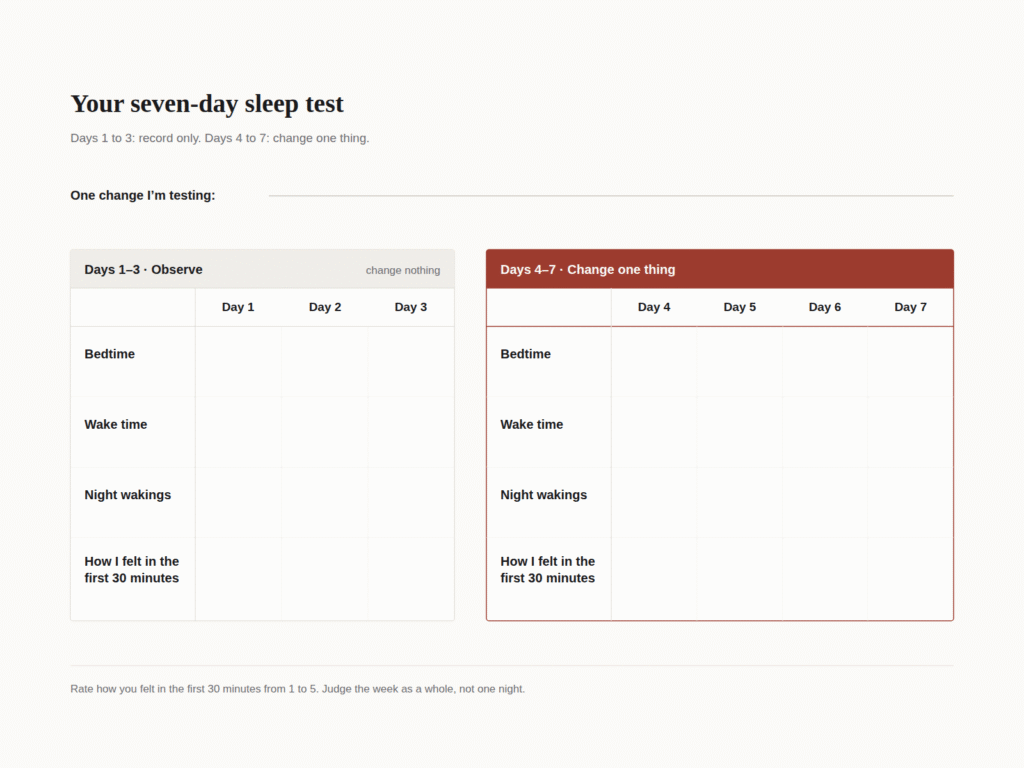
Days 1 to 3: change nothing. Write four things down.
Each morning, note your bedtime, your actual wake time, how many times you woke, and how you’d rate how you feel in the first half hour up, from one to five. A note on your phone is fine.
Days 4 to 7: change exactly one thing.
Start with the part of the schedule you can hold steady most easily: your wake time. Choose one, use it every day including the weekend, and get up when the alarm goes even if the night before was bad. Keep your bedtime flexible. Regular times at both ends are what your body clock works from.³
If that doesn’t fit your life, pick one of these instead: no caffeine after 5 p.m.; no screens in the hour before bed with the lights turned down, which is its own skill and these evening routines that calm the mind are the place to build it; or a bedroom colder and darker than usual. Everything else stays as it was.
Then decide.
Compare days 4 to 7 against days 1 to 3. Did your rating move? Did you wake fewer times? Judge the week as a whole, not one night.
If something moved, you’ve found your lever. Hold it for another week before changing anything else. If nothing moved, that’s a result too: the thing you tested isn’t your problem, so next week you run a different single change. What you must not do is conclude that none of it works.
Want the tracker as a single page you can print or keep on your phone? It’s here.
When it isn’t a routine problem
First, the distinction I promised.
Daytime sleepiness, clinically, is the inability to stay awake and alert during the day’s major waking hours. It shows up as an urge to sleep or as unintended lapses into drowsiness. Fatigue is different in an important way: it follows exertion, and it eases when you remove the demand or rest. That’s how the CDC’s occupational health researchers draw the line, and it matters because the fixes aren’t the same. Sleepiness responds to more or better sleep. Fatigue often doesn’t.⁹
A rough self-check: if you sat down somewhere quiet right now with nothing to do, would you drift off? If yes, more sleep hygiene may not be your answer. The AASM’s position is that sleepiness is a clinically significant symptom, not a complaint about being busy, and that it deserves proper evaluation.¹⁰
Use the test for ordinary, lifestyle-shaped tiredness, not as a substitute for a doctor. The NHLBI has one line worth knowing by heart: talk to your doctor if you sleep more than 8 hours a night but don’t feel rested, because that can point to a sleep disorder or another health problem.¹¹
The NHS gives specific reasons to see a GP:
- you have been tired for a few weeks and you’re not sure why
- your tiredness is affecting your daily life
- you’re tired alongside other symptoms, such as weight loss or mood changes
- you’ve been told you make gasping, snorting or choking noises while you sleep
That last one is the one people miss. The NHS links loud snoring, waking in the night and gasping or choking noises with sleep apnoea, where breathing briefly stops and restarts repeatedly during sleep. You can’t see that from the inside, which is why it belongs to a doctor.¹²
Mayo Clinic adds one more signal: needing naps more than usual, and especially still feeling sleepy after waking in the morning.⁸
Tiredness has many possible causes. Some, including anaemia, thyroid problems and diabetes, are medical rather than lifestyle conditions. Others sit in between: a mind that won’t switch off leaves you just as flat, and it’s a problem in its own right. That’s not a reason to be alarmed, only a reason to keep the test in its place.
Tomorrow morning
If your sleep schedule keeps moving around, start with your wake time.
Pick one. Set it tonight. Get up at it tomorrow, and again the day after, including the weekend. Everything here is measured from that point. One change done properly beats five attempted at once, which is how small habits tend to work in general.
Not the bedtime you aimed for. The morning that actually started.