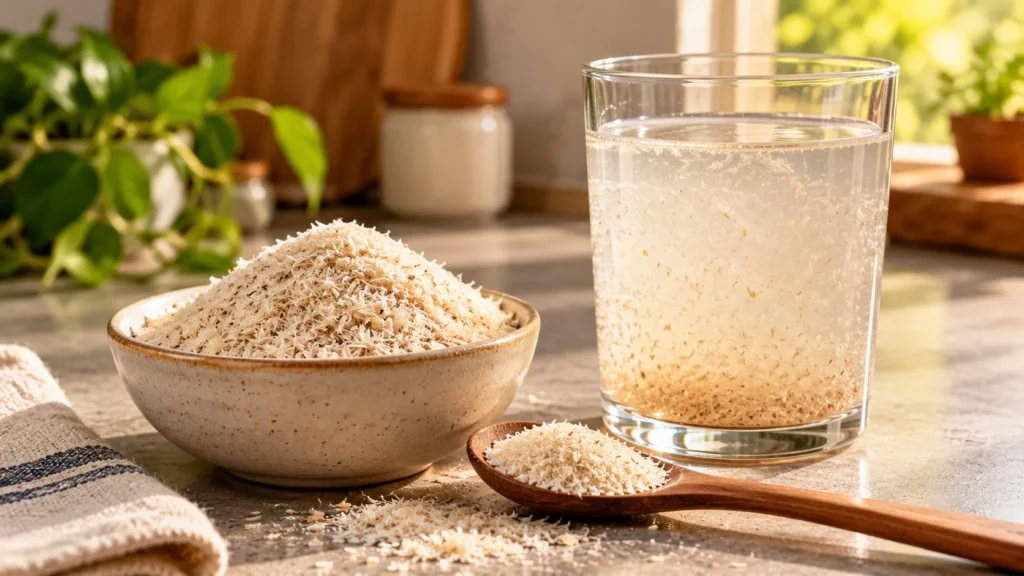
Isabgol, also called psyllium husk, is a fibre you mix with liquid and drink straight away. Use the amount on your pack, stir, and drink it before it thickens. That is the part that matters.
We did not find reliable clinical evidence that warm water works better than cold water, or worse. Of the official sources here, only the NHS names a temperature — cold water, for Fybogel.
Here is what the labels and health services really say.
What isabgol is
Isabgol is the common name in India. UK health pages call the same thing ispaghula husk, and US pages call it psyllium husk (Food Chem X review, 2021).
It is the husk of a small seed, and it is a type of soluble fibre. It absorbs water, swells, and makes your poo softer and bulkier. That is how it helps with constipation.
The NHS calls it a bulk-forming laxative, and says this is usually the first type to try if you are buying a laxative yourself (NHS).
It is sometimes used for other reasons, such as high cholesterol. But that is a decision for a doctor, not something to treat yourself (MedlinePlus).
Does warm water help it work?
There are two separate questions here, and only one of them has an answer.
In the glass: the mixture thickens as it stands, which is why the NHS and the US label both say to drink it straight away.
In your body: we did not find a clinical study comparing warm-water isabgol with cold-water isabgol for constipation. So we cannot say either works better — and we cannot say they are equal either. Anyone who tells you warm water “activates” it is going further than the evidence does. Food-science work on how psyllium thickens in water is about texture in a lab, not about constipation in people.
The official instructions are narrower than most people expect. The NHS tells you to mix Fybogel with “at least 150ml of cold water” (NHS). The US label says at least 8 ounces of water or other fluid, and gives no temperature (DailyMed). MedlinePlus says a pleasant-tasting liquid (MedlinePlus).
For Fybogel, follow the NHS instructions and use cold water. For other isabgol products, follow the directions on your own pack. We did not find reliable clinical evidence that warm water works better than cold water.
If you want the wider question answered — whether drink temperature affects digestion at all — we cover that in warm vs cold water for digestion.
How to take it
- Put one dose of isabgol into a dry glass.
- Add water. The NHS says at least 150ml for Fybogel. The US label and MedlinePlus both say 8 ounces, about 240ml.
- Stir until there are no dry lumps. Fybogel granules go clear or slightly hazy. Loose husk stays cloudy, and that is normal.
- Drink it straight away. If it thickens before you finish, add more water, stir, and drink.
- Keep drinking water through the day. The NHS says to drink extra fluid while taking it.
Never take it dry, and never swallow a thick lump. The US label warns that isabgol without enough fluid can swell and block your throat, and cause choking (DailyMed). The NHS says do not take it at all if you have difficulty swallowing or any throat problem (NHS).
How much to use
It depends on what you bought, so check the pack first. Instructions are not interchangeable between brands.
Fybogel sachets (UK): the NHS dose for adults and children aged 12 and over is one sachet twice a day (NHS). That is a dose for that product only. It does not carry over to loose powder, and it does not tell you anything about an Indian brand.
Loose powder, including Indian brands: there is no single dose to give you, because the products differ. Follow the pack you bought. The only label figure I can quote comes from one US product, which says one rounded teaspoon — about 3.4g — in a full glass, up to three times a day (DailyMed). Your pack may say something different, and your pack is the one to follow.
If you are new to fibre, that US label suggests starting with one serving a day and building up. That is sensible, because wind and bloating are the usual reasons people stop.
If you forget a dose, skip it. Never take two to catch up (NHS).
Children: the instructions differ by product, so do not guess.
- Fybogel granules (NHS): ages 6 to 11, half to one level 5ml teaspoon twice a day. For children aged 5 and under, only if a doctor recommends it (NHS).
- The US label: ages 6 to 11, half an adult dose in a full glass. Under 6, ask a doctor (DailyMed).
If you are unsure which set applies to the product you have, ask a pharmacist.
How much water
There are two official figures, and they belong to different products.
- NHS, for Fybogel: at least 150ml of cold water to mix each sachet.
- US label and MedlinePlus, for the psyllium products they cover: at least 8 ounces, about 240ml.
Neither is a universal isabgol instruction. Use the amount on your own pack, and ask a pharmacist if the pack does not say.
Then there is the rest of the day. The NHS says adults should aim for more than 2 litres, or about 8 glasses, of fluid a day while taking it. It also warns that if you do not drink enough, your constipation may get worse.
One exception: if a doctor has told you to limit your fluids — heart failure and kidney problems are the usual reasons — ask before increasing how much you drink. The NHS lists heart conditions as a reason to check with a pharmacist before using laxatives (NHS).
When it starts working
Not straight away.
The NHS says 2 to 3 days (NHS). The US label is a little broader: a bowel movement in 12 to 72 hours (DailyMed).
Give it a few days. If nothing has changed after 3 days, speak to a doctor or pharmacist. And do not keep buying laxatives: the NHS says not to use them for longer than 7 days without advice (NHS).
Taking it with other medicines
Isabgol can affect how well other medicines are absorbed. The NHS puts it plainly: it “can affect how other medicines, vitamins and supplements are absorbed” (NHS).
The advice on how far apart to take them is not identical everywhere:
- The NHS how-to page says at least 30 minutes before or after other medicines.
- The NHS medicines page says more than an hour before or after.
- The US label says 2 hours before or after a prescribed medicine.
- MedlinePlus says 3 hours for digoxin, aspirin and nitrofurantoin specifically.
Because these differ, there is no single number I can honestly give you. Read the leaflet in your own pack, and ask a pharmacist — especially if you take lithium, carbamazepine, digoxin, insulin or other diabetes medicines, mesalazine, or codeine. The NHS names all of those (NHS).
Who should check first
Speak to a doctor or pharmacist before using isabgol if you (NHS):
- have difficulty swallowing, or any throat problem
- have tummy pain and feel sick or are being sick, as these can be signs of a bowel blockage
- have blood in your poo, or a change in how often you poo that has lasted more than 2 weeks
- have a condition where the muscles of your bowel are weak, which the NHS calls colonic atony
- have phenylketonuria (PKU), a rare inherited condition, because some products are sweetened with aspartame and carry a phenylalanine warning
- have had an allergic reaction to isabgol or another medicine
MedlinePlus also advises telling your doctor if you have diabetes, heart disease, high blood pressure, kidney disease, or rectal bleeding (MedlinePlus).
Pregnancy and breastfeeding
The advice is a little split, so it is worth a quick check.
The NHS page for Fybogel says most adults can take it, including while pregnant or breastfeeding (NHS). The NHS’s general laxatives page says to check with a pharmacist first if you are pregnant or breastfeeding (NHS).
Neither says no. Both point to asking, which takes a minute at a pharmacy counter.
Side effects
Wind and bloating are the usual ones. They tend to settle after a few days (NHS).
A mild allergic reaction is possible: itchy eyes, nose or skin. If that happens, stop and ask a pharmacist.
A serious allergic reaction is rare, but know the signs. Call your local emergency number immediately if your lips, mouth, throat or tongue swell, if you are struggling to breathe, or if your throat feels tight.
Also: do not breathe in the powder while mixing it. It can irritate your nose and throat, and the label warns it can cause a reaction in people sensitive to psyllium.
If you get chest pain, vomiting, or difficulty swallowing or breathing after taking it, get medical help straight away (DailyMed).
When to see a doctor
See a doctor if you (NHS):
- are constipated and it is not getting better with treatment
- are regularly constipated
- are regularly bloated
- have blood in your poo
- have lost weight without trying
- are constipated and feel tired all the time
- are taking a medicine that causes constipation, such as opioid painkillers
- notice a sudden change in your bowel habits
- have tummy pain
None of these is a reason to take more fibre.
If bloating is your main problem rather than constipation, our guide to gas, bloating and heartburn at home covers what is worth trying.
Common mistakes
- Taking it dry, or with a small splash of water.
- Drinking it slowly while it thickens.
- Using the Fybogel sachet dose for loose powder, or more than the pack says.
- Taking it at the same time as your tablets.
- Expecting it to help you lose weight.
On that last one: isabgol is fibre, not a fat burner. The label says it helps you feel less hungry between meals (DailyMed), and the NHS says most adults eat about 20g of fibre a day when they should have 30g (NHS). It does not cancel out what you eat. No supplement can do that.
If you would rather get your fibre from food, our guide to the best foods for digestion is the place to start.
The bottom line
For Fybogel, use cold water as directed. For other products, follow your pack’s instructions. We did not find reliable clinical evidence that warm water works better than cold water.
Use the amount of liquid on your pack. Drink it straight away. Keep drinking enough fluid through the day, following your product instructions and any fluid limits your doctor has given you. Take it apart from your other medicines, and check your own leaflet for exactly how far apart. Give it a few days before deciding it has not worked.
And if you are constipated often, or something has changed, see a doctor. Fibre is a useful habit, not a diagnosis.