
What to Prioritise, What to Skip, and How to Keep It Going
Most advice about daily habits assumes the problem is that you do not know what to do. That is rarely the problem. The problem is that the list is longer than the day.
So this is a shorter list. Four habits, each in three versions, arranged so that a difficult week does not dismantle the whole thing.
You do not need to do everything. You need to keep the four things that carry the rest — and to know which version of them today can hold.
Everything below is an arrangement of effort, not a dose. Where the evidence is strong, we say so. Where it is thin, or where the sources disagree with each other, we say that too.
The short answer
Four habits. Three versions. That is the whole routine.
If today is difficult, use Minimum. It is the floor, not a failure.
A consistent sleep schedule. Go to bed and get up at roughly the same times each day. This is the fixed point the rest hangs from.
Daytime movement. Any short bout counts. A brisk ten-minute walk counts toward the weekly total.
Time outdoors / daylight. Get outside at some point in the day. No particular time is required.
A wind-down boundary. Decide where the day stops, and let the last part of it be calm.
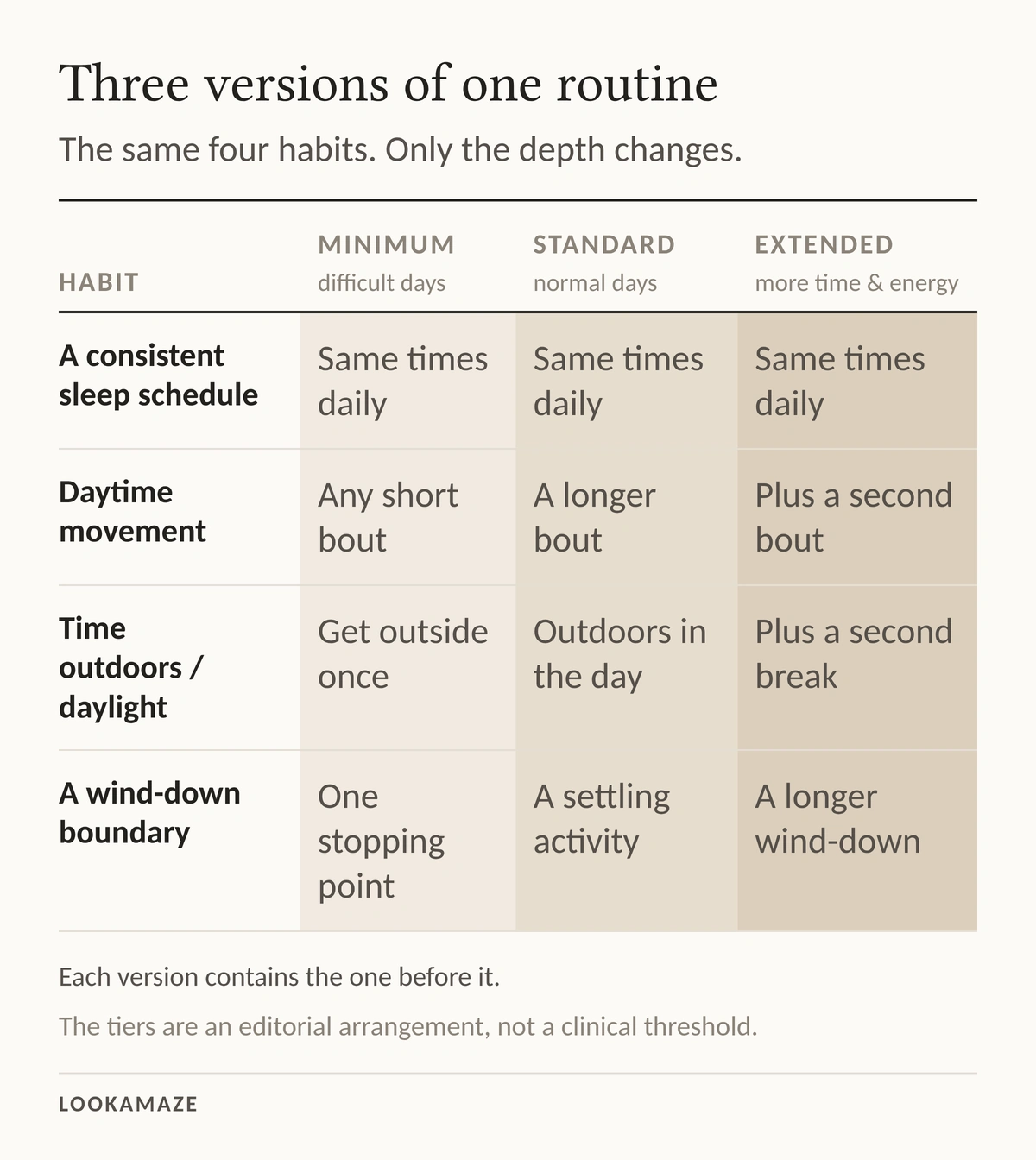
Then three versions of the same four:
- Minimum — for the days when everything is already too much.
- Standard — for ordinary days. This is the version most people will live in.
- Extended — for days with more time and energy.
Each version contains the one below it. Nothing gets swapped out as you move up; the same four habits simply get more room.
This is an editorial arrangement, not a clinical threshold. It is what we would prioritise, and why. Not a dose, and not a promise.
The routine, tier by tier
The three versions are not three different routines. They are the same four habits at three levels of depth. Start wherever your day allows, and move between them without ceremony.
Minimum — for difficult days
This is the version for days when you are already stretched. It is deliberately small.
Sleep schedule. Protect the times. Getting up at roughly the same time matters most here, because it keeps the clock steady while everything else wobbles.
Movement. One short bout. A few minutes of walking, at any pace that suits you.
Time outdoors / daylight. Get outside once, however briefly.
Wind-down. One stopping point. Pick a moment in the evening and treat it as the end of the working part of the day.
That is the whole thing. A day built this way is not a wasted day.
Standard — for ordinary days
This is the version to aim for on a normal day, and the one most people will settle into.
Sleep schedule. The same times, held deliberately.
Movement. A longer bout — a proper walk, or whatever form of movement you will actually repeat.
Time outdoors / daylight. Outdoors during the day, wherever it fits.
Wind-down. A settling activity before bed, rather than only a stopping point.
If you want the components of a workable start to the day, we have written about shaping the first part of your day. The other end of the day is covered in winding down before sleep. This article sets the priority order. Those two carry the detail.
Extended — for days with more time and energy
Sleep schedule. Unchanged. This is the one item that does not scale up.
Movement. The main bout, plus a second short one later in the day.
Time outdoors / daylight. A second outdoor break, if the day allows.
Wind-down. A longer wind-down, with more space between stopping and sleeping.
Extended is not something you earn. It is what the routine looks like when the day gives you room.
The time budget
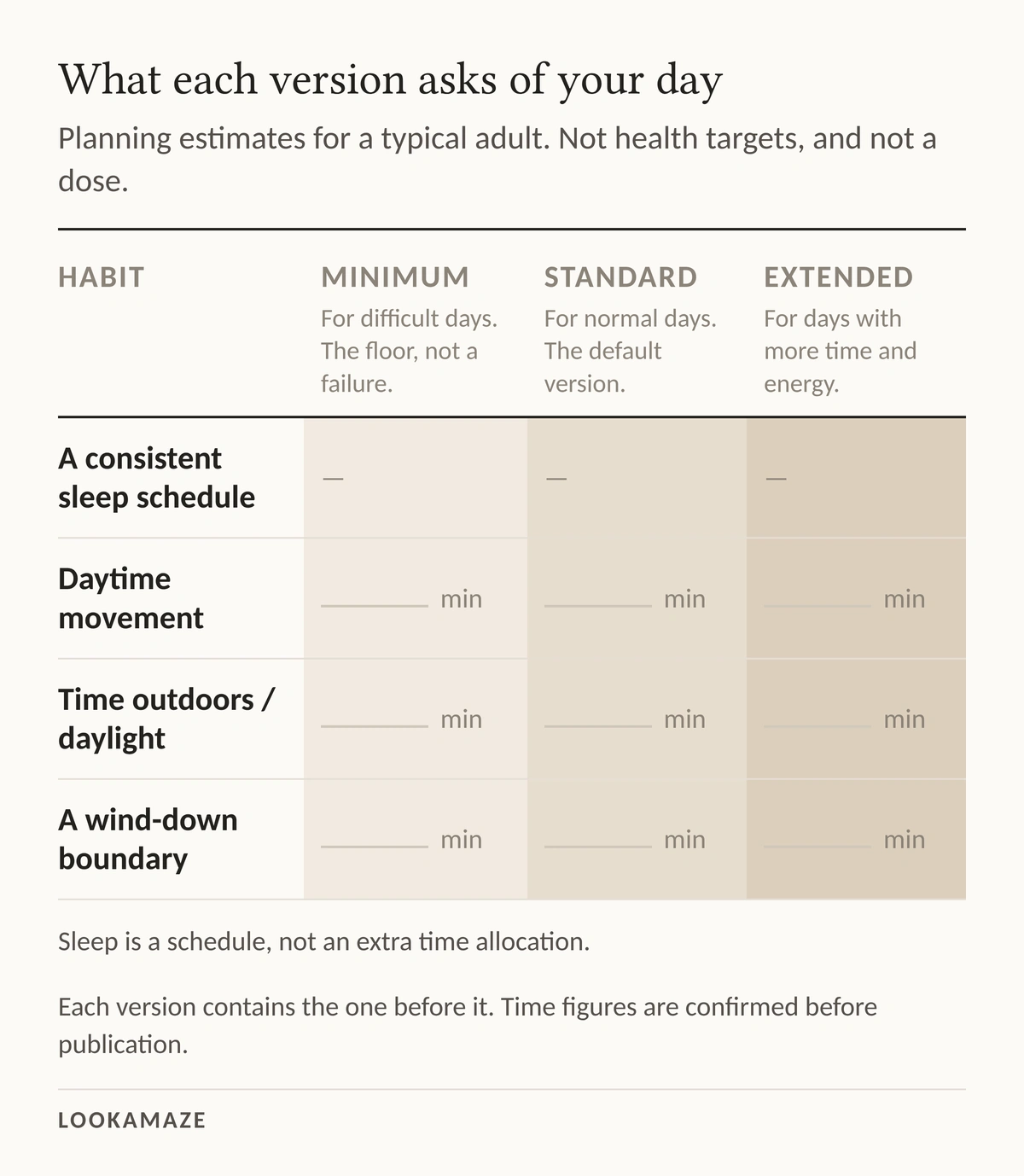
We are not publishing minute targets, and that is a deliberate choice rather than a gap we forgot to fill.
Time costs vary enormously between people. A walk around the block and a session at a gym are both “movement”, and the distance between them is about an hour. A single number per tier would imply a precision the underlying guidance does not have — and you would reasonably read it as a target to hit.
What we will say instead: Minimum is built to fit inside a difficult day without displacing anything else. Standard is built to fit inside an ordinary one. Extended is what you do with slack, not what you owe.
The one figure we can give you comes from the movement guidance, and it applies to the week rather than to any tier. Adults should aim for at least 150 minutes of moderate activity a week, or 75 minutes of vigorous activity, spread across four to five days, with strengthening work on at least two days. A brisk ten-minute walk counts toward that total.
Two things in that guidance are easy to miss. The first is that any amount is better than none, and all activity counts. The second is that the guideline is a destination, not a starting line. If you are nowhere near it, the useful first step is not 150 minutes — it is one walk.
Why these habits, and not others
Any list of daily habits could run to twenty items. This one runs to four, and the reason is not that the other sixteen are worthless. It is that a routine you cannot keep is worth less than a smaller one you can.
The three things that decide a habit’s place
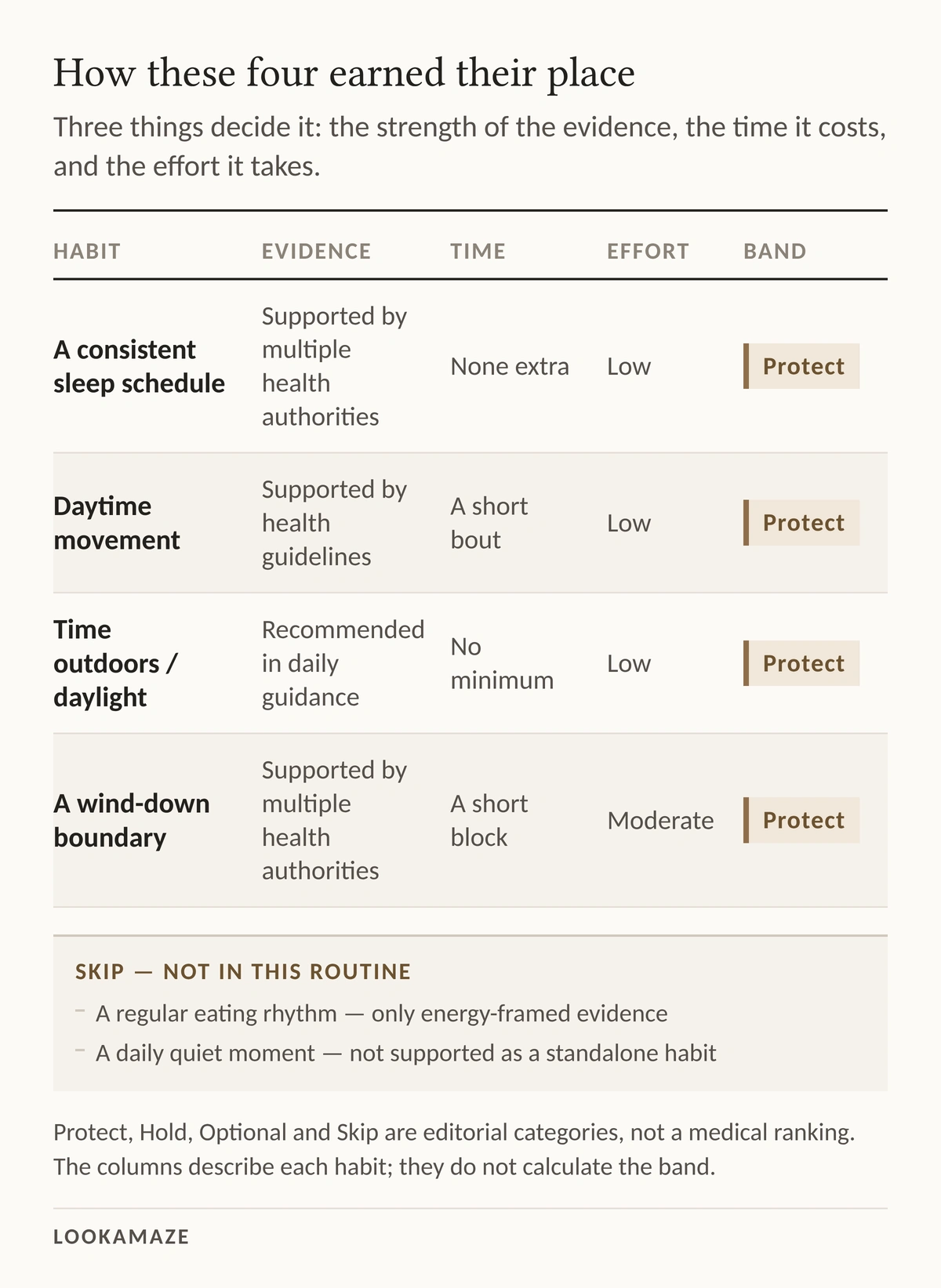
Every habit in this routine had to survive three questions.
How strong is the evidence? Some behaviours are recommended by multiple health authorities. Others rest on a plausible mechanism and thinner support. We treated those as different, and said so.
What does it cost in time? A habit that needs an hour is not competing on equal terms with one that needs five minutes.
How much effort does it take? Time and effort are not the same thing. A ten-minute walk costs ten minutes and almost no willpower. Changing when you go to bed costs no extra minutes at all, and can be genuinely hard. We kept those separate.
The four bands
Once a habit has been through those three questions, it lands in one of four places. These are editorial categories. They describe how a habit is treated in this routine. They are not a medical ranking, and nothing in this article calculates them.
Protect — it appears in every version, including Minimum.
Hold — it belongs in Standard and Extended, but not on a difficult day.
Optional — worth doing when there is room, harmless to skip.
Skip — it is not part of this routine, for a reason we state.
All four retained habits sit in Protect. That is why the Minimum version still contains all four.
Why we left things out
Leaving something out of a routine says nothing about whether it is safe, risky, useful or harmful. It says it is not part of this arrangement — and for the two items below, the reason is specific.
A regular eating rhythm is not part of this routine. We looked for support for it as a general daily habit and could not find it at the standard we used elsewhere. The evidence we did find framed regular meals around energy in the context of tiredness, not as a general wellness behaviour. It is a reasonable thing to do. It is not in this routine, and we would rather say that plainly than dress it up.
A daily quiet moment is not part of this routine. The verified evidence for mindfulness concerns specific mental health contexts. The sources are also careful to note it does not suit everyone — for some people it makes things worse. That is a real caveat attached to a real intervention, and it does not belong in a daily routine presented as suitable for a general reader. The relaxation element that is well supported sits inside the wind-down habit, where the guidance places it.
Supplements are also not part of this routine. Nor is a fixed screen cut-off figure — see below.
Where this guide stops and your situation starts
This routine assumes a broadly healthy adult with an ordinary amount of control over their own day. It is designed to be low-risk rather than personalised.
If you are pregnant, managing a chronic condition, taking medication, working shifts, or recovering from illness, the general advice here may still be useful, but it is not advice for you. Your situation overrides every line of it.
For everyone else, there is one instruction that outranks the rest: if a habit genuinely does not fit your life, change the habit, not your assessment of yourself.
The priority order: what earns a place, and why
Here is each habit in turn. What it is, why it sits where it sits, and — just as important — what it will not do.
A consistent sleep schedule
Go to bed and get up at roughly the same times each day. That is the whole instruction.
It comes first because it is the only item here that costs no extra time and still changes the shape of everything else.
Regular timing is recommended by multiple health authorities, and it is one of the few pieces of advice that is consistent across them.1,2,5 The National Heart, Lung, and Blood Institute, a US government body, adds a practical tolerance: keep the difference between weeknights and weekends to about an hour.3 That is a useful detail, because “be consistent” without a number is hard to act on.
One clarification the guidance does not make for us. Every source we verified pairs going to bed with getting up. None of them recommends a consistent wake time on its own while letting bedtime drift. So we have not separated them here. Hold both times, or as close to both as your week allows.
If mornings are the part of the day you find hardest to shape, we have written separately about building a start to the day that actually fits.
What this will not do. A consistent schedule will not fix insomnia, and it does not guarantee better sleep. It is a timing arrangement, not a treatment. If sleep problems persist, that belongs with a clinician — see the section further down.
Daytime movement
The Minimum version of this habit is deliberately vague: one short bout, at any pace. That is not laziness. The activity guidance says plainly that any amount is better than none, and that all activity counts.6
It sits second because the evidence here is the strongest of the four, and the cost is the most variable. A ten-minute walk and a ninety-minute session both count as “movement”, and pretending they are equivalent would be dishonest. So the guideline sits in Standard and the floor sits in Minimum.
The figures are worth knowing even if you never hit them. Adults should aim for at least 150 minutes of moderate activity a week, or 75 minutes of vigorous activity, spread across four to five days, with strengthening work on at least two days. A brisk ten-minute walk counts toward the total.7,8 The guidance also asks you to break up long periods of sitting, which is a different instruction from exercising — and, for most people, an easier one to act on.
What this will not do. It will not guarantee weight loss, and it is not a treatment for any condition. It will not make up for a week of poor sleep, and it is not a substitute for care.
Time outdoors / daylight
Get outside at some point during the day. That is the habit. There is no time attached to it, and that is not an oversight.
Light is one of the main cues your body uses to tell day from night. The National Heart, Lung, and Blood Institute describes light signals reaching your eyes as telling your brain that it is daytime, and notes that bright artificial light late in the evening can disrupt that process. The same source recommends spending time outside every day, when possible.4
What it does not do is specify a time of day. We looked for a non-commercial source recommending early-day or morning light specifically, and could not find one that supports a timing claim. So we are not making one. If you find that going outside earlier suits your day, that is a reasonable preference. It is not a requirement of this routine, and nothing here depends on it.
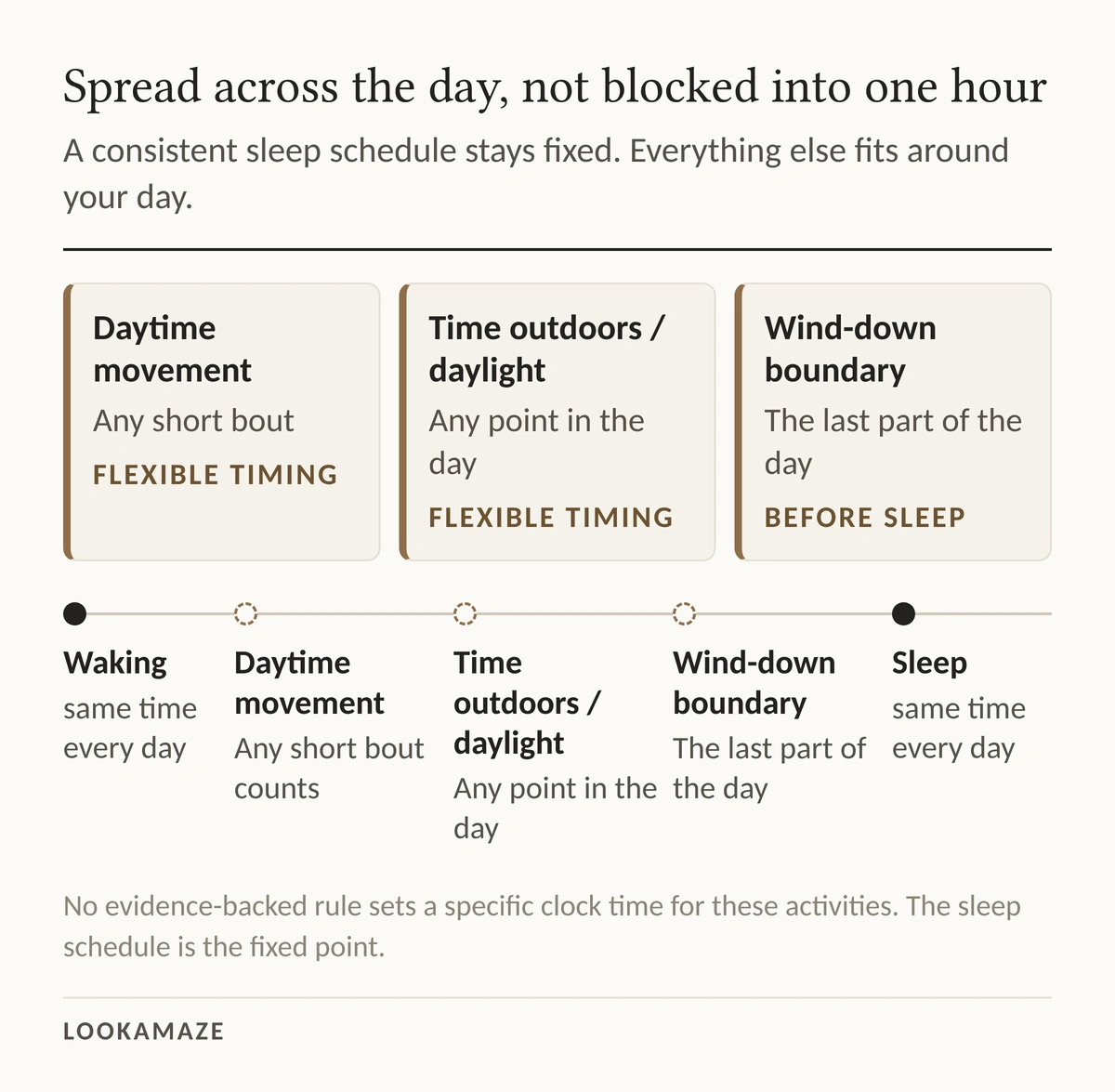
That matters for how you read every other habit too. There is no clock position in this routine. The sleep schedule holds the two fixed points at each end of the day. Everything else fits between them.
What this will not do. It will not “detox” anything, it will not reset your hormones, and it will not boost your immune system. It is also not a reliable cure for low mood. This is deliberately unglamorous: it is a behaviour with a clear mechanism behind it and a modest, honest claim attached.
A wind-down boundary
Decide where the day stops. Then let the last part of it be calm.
This is the habit most likely to feel optional and least likely to be. Sleep guidance from multiple authorities recommends a relaxing routine before bed, and this is one where the practical advice is unusually specific.1,2,3
Both the CDC and the American Academy of Sleep Medicine suggest turning off electronic devices at least 30 minutes before bedtime. The National Heart, Lung, and Blood Institute frames it more broadly. It suggests using the hour before bed for quiet time, avoiding intense exercise and bright artificial light, and — if it suits you — a hot bath or a relaxation technique. Limiting bright light in the evening appears across the guidance. If you want the practical version — what a wind-down actually looks like, hour by hour — we have written about winding down before sleep.
One thing we are not going to settle for you. The screen cut-off figure is genuinely unresolved. The recommendations we verified span roughly 30 minutes to a few hours before bed, and they are not measuring the same thing — some describe turning a device off, others describe reducing use. Separately, a study registered with the NHS Health Research Authority states that it is unclear whether screen use causes poor sleep in the first place.9 So there is no single number here that we could give you honestly.
What this will not do. A wind-down boundary will not cure insomnia. If you are consistently unable to fall asleep despite doing this, the boundary is not the problem and no amount of refining it will be. That is a clinical question.
What to skip, and why
Skipping something is not a verdict on it. Every item below is simply not part of this routine, and each one has a reason.
A fixed screen cut-off figure is not part of this routine. The underlying advice disagrees with itself, as set out above. What is in the routine is the boundary itself — deciding where the evening stops. The number is the part we cannot source honestly.
Supplements are not part of this routine. Nothing here requires one, and this article is not the place to recommend one. If you take something on advice from a clinician, that is between you and them.
A “detox” is not part of this routine. Nor is anything that claims to clear toxins, reset hormones, or balance cortisol. Your body handles those processes without a product, and no verified source supports a habit that improves them.
Counting is not part of this routine. You are not asked to log minutes, steps or calories. If tracking helps you, that is fine — but it is not a requirement, and the routine works without it.
Early-day timing is not part of this routine. There is no morning requirement anywhere in it. If your day starts late, nothing above changes.
One more thing worth stating, because it is the reason this list is short. Ten habits you half-do is not better than four you mostly do. The restraint is the point.
What this routine cannot do
This is the section that matters most, and the one most wellness writing leaves out.
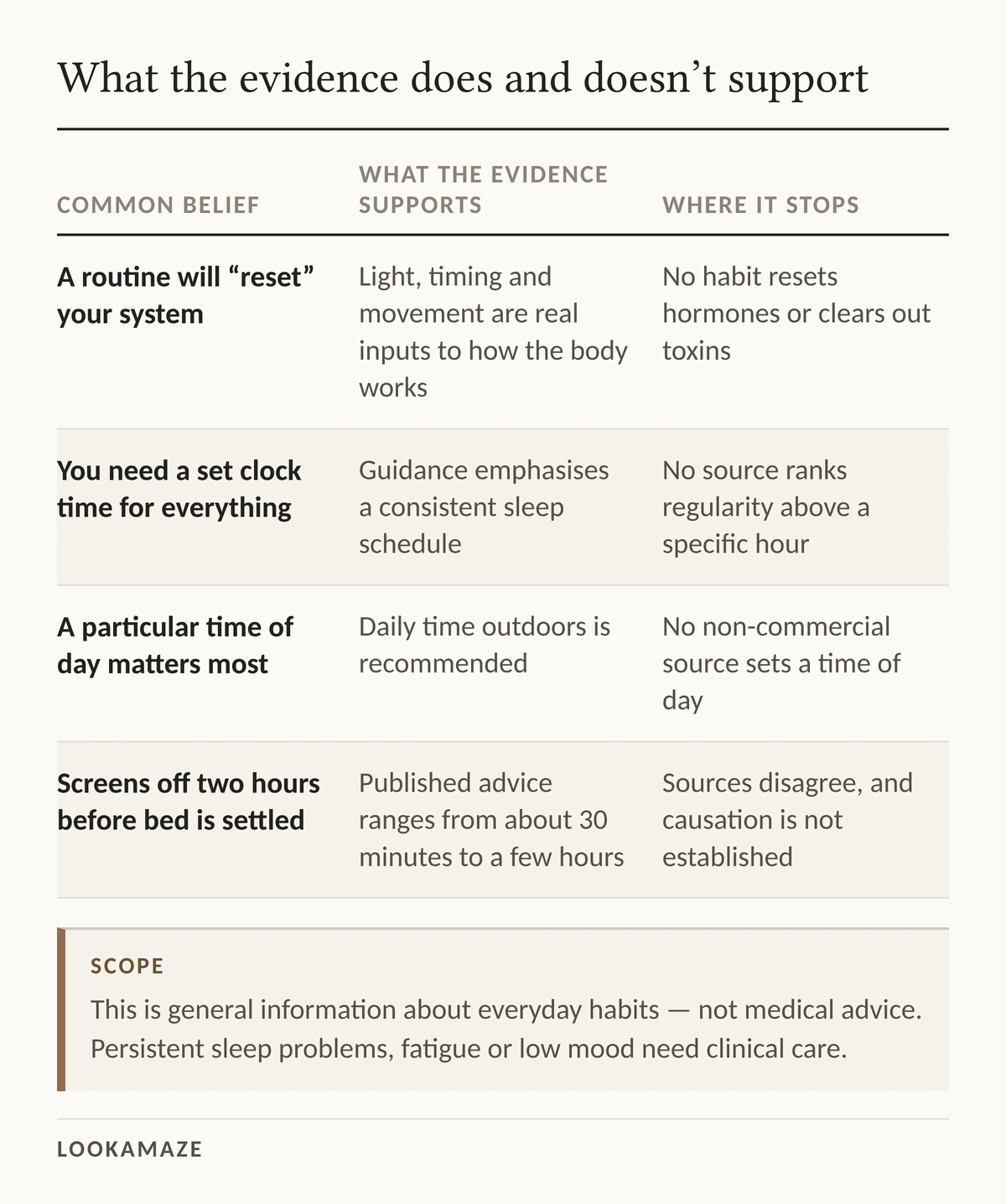
It will not remove toxins. No habit here clears anything your liver and kidneys are not already handling.
It will not reset your hormones or your cortisol. Light, timing and movement genuinely affect how your body works. None of them resets an endocrine system, and anyone telling you otherwise is selling something.
It will not boost your immune system. It will not prevent disease, and it is not a treatment for any condition.
It will not guarantee better sleep, more energy, weight loss, or a longer life. Those outcomes are not promised here, because the evidence does not promise them. What the guidance supports is narrower and more useful: a set of behaviours that are reasonable to do, at a cost you can actually sustain.
It is not a substitute for medical care. It is general information about everyday habits. That distinction is the whole reason the next section exists.
Where the sources disagree, this article says so rather than picking the more satisfying answer. That is why the screen timing figure above is left open. We would rather leave a gap than fill it with something we cannot support.
What to do when the routine breaks
It will break. That is not a failure of the routine or of you.
When it does, the move is not to restart at Standard. Drop to Minimum, and stay there until the week stops being difficult. The Minimum version exists precisely so that a bad stretch does not become an abandoned routine.
Two things make the difference between a break and an ending.
Return to the anchor first. If you can only hold one item, hold the sleep times. Everything else in this routine sits more easily on a steady clock, and re-establishing it is the fastest way back.
Do not wait for a clean week. The most common way a routine dies is the belief that it should restart on Monday. It should restart today, at whatever level today allows.
If you want to understand why routines collapse — starting small, making a habit repeatable — that is a subject in its own right, and we have covered it in how small habits actually hold. This article sets the priority order. That one explains the machinery.
When to talk to a professional instead
Some things do not belong in a routine, and this section is here so you do not spend months trying to solve them with one.
Persistent sleep problems. If you consistently cannot fall asleep or stay asleep despite holding a steady schedule and a wind-down, that is a clinical question, not a scheduling one. Guidance is explicit that a routine is not a treatment.
Fatigue that does not shift. Ordinary tiredness responds to sleep and activity over time. Tiredness that persists regardless of both is worth investigating rather than pushing through.
Low mood that lasts. The relaxation element inside the wind-down habit is a comfort, not a therapy. If low mood is persistent, the appropriate help is professional.
If you have not been active recently, or you have a medical condition, national guidance is clear that you should speak to a doctor before starting a new exercise routine.7 That is not a formality. It is there because exercise is a real physiological intervention, and its risks depend on you.
If you work shifts, the sleep guidance that assumes a conventional day does not transfer cleanly. There are approaches designed for shift schedules, and they are best set up with someone who understands your roster rather than adapted from an article.3
None of this is a reason to avoid the routine. It is a reason to keep it in its place: a good arrangement of ordinary days, not a medical instrument.
The one-page routine
Minimum — a difficult day
- Sleep: hold your two times.
- Movement: one short bout.
- Outdoors: get outside once.
- Wind-down: one stopping point.
Standard — an ordinary day
- Sleep: the same two times, deliberately.
- Movement: one longer bout.
- Outdoors: outdoors during the day.
- Wind-down: a settling activity before bed.
Extended — a day with room
- Sleep: unchanged.
- Movement: the main bout plus a second short one.
- Outdoors: a second break.
- Wind-down: a longer one.
Each version contains the one below it. Start at Minimum on the days you need to. Move up when the day allows, and back down without drama when it does not.
FAQ
Do I have to do all of this every day?
No. The Minimum version is a complete version of the routine, not a half-finished one. Doing Minimum on a hard day is the routine working as designed.
What if I only have a few minutes?
Use Minimum. It is built for that. A single short walk and an on-time bedtime is a legitimate day.
Is it better to do everything at the same time each day?
Only the sleep times carry a timing instruction, and that instruction is consistency rather than a specific hour. The other three habits are deliberately flexible — they fit around the day rather than into a slot.
What time should I wake up?
We are not going to give you a clock time. The guidance emphasises a consistent schedule, and the National Heart, Lung, and Blood Institute suggests keeping the difference between weeknights and weekends to about an hour. What the sources do not do is rank consistency above a specific hour, so we have not either. If sleep is affecting your life, your own timing is a question for a clinician.
Do I need to count steps or minutes?
No. Counting is not part of this routine. The guideline figures are there so you know what the guidance says, not so you can audit yourself against it.
Are supplements part of this?
No. Nothing in this routine requires one, and this article does not recommend any. Anything you take on a clinician’s advice is a matter between you and them.
Can I do this if I work nights?
The schedule advice in this routine assumes a conventional day. Shift work changes the problem rather than the discipline, and the standard guidance does not transfer cleanly to it. There are approaches built specifically for shift schedules, and they are best set up with someone who can account for your roster.
Will this help me lose weight?
We are not going to say yes. Movement and sleep are both worth doing on their own terms. But this routine was not built around weight, it makes no weight claim, and weight is not how we would suggest you judge whether it is working.
Should my routine include a daily meditation or mindfulness practice?
It is not part of this routine, and the reason is specific rather than dismissive. The evidence we verified supports mindfulness in particular mental health contexts — the NHS describes it as helping with stress, anxiety and depression, with more research needed elsewhere. The same source is explicit that it does not suit everyone, and that some people find it makes them feel worse. That is a real caution attached to a real practice, so it does not belong in a routine presented as suitable for everyone. The relaxation element inside the wind-down habit is the part the sleep guidance actually supports.
What about screen time before bed?
The honest answer is that the published advice does not agree. The recommendations we verified span roughly 30 minutes to a few hours before bed, and they are not all measuring the same thing. There is also a registered study stating that it is unclear whether screen use causes poor sleep in the first place. So: keep the boundary, and treat the number as unsettled. If notification interruptions rather than screen light are your real problem, we have written about cutting down interruptions.
Sources and scope note
Every health claim in this article was checked against a named source and re-read before publication.
Sleep and the body clock. 1US Centers for Disease Control and Prevention, About Sleep. 2American Academy of Sleep Medicine, Healthy Sleep Habits. 3US National Heart, Lung, and Blood Institute, Healthy Sleep Habits and 4What Makes You Sleep? 5National Health Service, Self-help tips to fight tiredness.
Physical activity. 6World Health Organization, Physical activity fact sheet. 7National Health Service, Physical activity guidelines for adults aged 19 to 64 and 8Walking for health.
Screens and sleep. A research summary registered with the 9NHS Health Research Authority on screen use at bedtime. 10One commercially funded but medically reviewed summary of light and sleep was used only for mechanism detail, and not for any claim about outcomes.
Where a source was limited, we have said so in the text rather than smoothing it over. Where sources disagreed, we left the disagreement visible. Where we could not verify a claim at all, we removed it — which is why this routine has four habits rather than fifteen.
Scope. This is general information about everyday habits. It is not medical advice, and it is not a treatment for any condition. Persistent sleep problems, fatigue or low mood need clinical care.
You can read more about who publishes this site on our about page, and the terms that govern it in our disclaimer.