Most homes are not messy because they hold too much. They are messy because a handful of everyday items have no place that matches where they are actually used. Keys come in the door and go down on the nearest flat surface. A bag is left wherever there is floor space. A charger lives in a drawer in another room. That is a placement problem rather than a discipline problem, and placement is easier to fix.
Notice where things are really used, then give them a home close to that spot. Nothing has to be thrown away, and you are not being asked to own less.
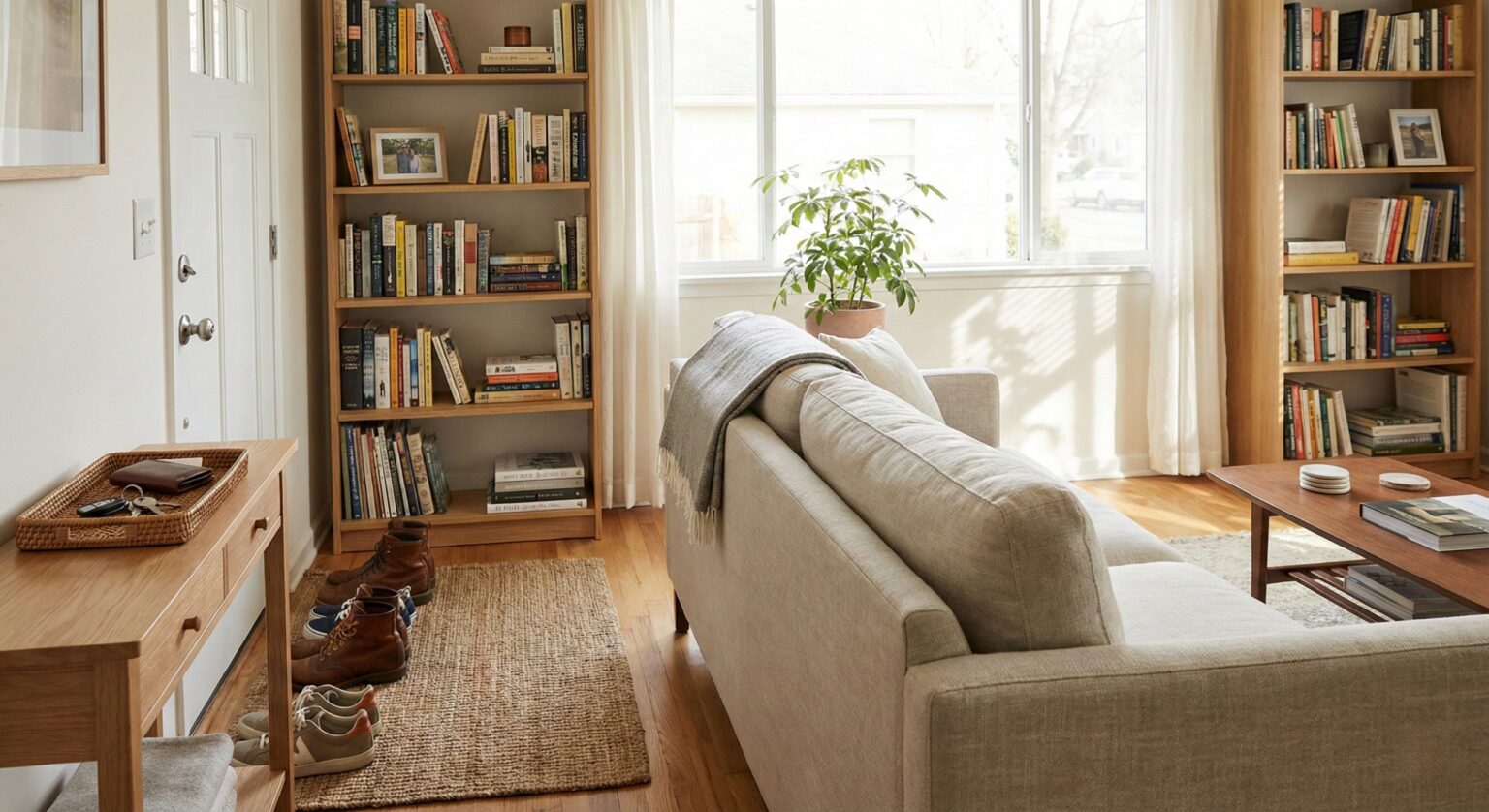
Start With Where Things Are Actually Used
Before you move anything, notice where things already end up — not where you think they should go.
Start at the entry. If keys, a wallet and a bag are used every day, the moment they come through the door is the moment they need somewhere to go. If that somewhere is a hook in a bedroom, they get dropped on the first flat surface instead. That surface is not the problem — the distance is.
The same test works anywhere. Glasses used mostly at a desk belong near the desk. A charger for a phone used on the sofa keeps migrating to the sofa unless it has a place there. An item that keeps moving is stored too far from where it is used.
Give Everyday Items a Fixed Home
Once you know where something is used, give it one place — an item with two possible homes effectively has none.
Some items earn a spot in the open: a tray by the door for keys, a hook for the bag that leaves every morning, a basket on the desk for the charger. Anything touched several times a day should be easy to reach and easy to put back; if it takes more than a moment, it will be left out.
Things used less often can live further away: spare cables, the toolbox, seasonal items. Access matters more than neatness — a crowded shelf where everything is visible beats an elegant cabinet where nothing is. If reaching a daily item means opening two doors and shifting a stack, it will end up back on the counter.
Fix the Surfaces That Keep Refilling
Some flat surfaces refill however often they are cleared: the kitchen counter, the dining table, the chair in a bedroom. Whatever keeps landing there has no home within reach.
Instead of clearing the surface over and over, name the two or three things that keep appearing and give each one a place. Papers that pile up on a table need a tray or folder close enough that using it is easier than adding to the pile. Groceries and post land on the counter because they are set down on the way in, so a defined corner for them keeps the rest clear.
It also helps to keep one small part of a busy surface deliberately clear — the area you actually use to cook or work.
Stop Drawers and Cabinets Becoming Dumping Zones
A catch-all drawer begins with good intentions. Then an item arrives that belongs nowhere in particular, the drawer is the nearest option, and within a month it holds unrelated things.
Make the drawer’s purpose specific enough that an item either fits it or does not: a drawer for batteries, tape and spare chargers is clear, a drawer for useful things is not.
Take the contents out in one go. Sort what you find into three groups: things that belong in this room, things that belong elsewhere in the home, and things you cannot find a use for. Put the first group back and carry the second to where it belongs while the pile is in front of you. Cabinets work the same way: one holding everything from cleaning supplies to spare bags makes you dig every time.
Reduce What You Have to Move Before You Can Clean
A surface is easy to clean when nothing is on it, and hard when clearing it takes ten minutes. Count what must be moved before you can wipe it down, then reduce that number.
Kitchen counters are the clearest example. If a toaster, a kettle, a knife block, a jar of utensils and three bottles all live on the counter, cleaning it means moving every one. Some need to stay out; others can move to a shelf just inside a door where they are still within reach.
Anything used several times a day can stay out; anything used weekly is better stored. You are not aiming for an empty counter, but for one that takes a moment to clear rather than a task. The same applies to tables, desks and bedside surfaces.
Change a Storage Spot That Keeps Failing
If a storage spot keeps failing after you have tried it, that is information, not a personal failing. Some placements do not survive real life, so change it instead of trying harder.
Signs a spot is failing: the same items keep accumulating beside it rather than inside it; things that go in are never used again; the container is full at the top while the space underneath sits empty; you avoid opening it because something might fall out.
When that happens, change the location so storage sits where the items are used, not where it was convenient to install. Or change the container, so it fits what is actually being stored — a shallow tray keeps small items visible where a deep drawer hides them.
Give the new arrangement a couple of weeks. If things are still collecting beside it, the placement is still wrong, and the next change should be to the location rather than to your effort. A home that works is not one where every system succeeds on the first attempt — it is one where failing spots get swapped until they fit how the household actually lives.