If you’ve noticed that workouts feel heavier than they used to, you’re not imagining it. Muscle can become gradually harder to maintain as men get older, although when those changes become noticeable varies a lot from person to person.
Here’s the part most articles skip: losing a little muscle with age is normal. Losing a lot is not inevitable. What you do week to week can make a meaningful difference. This article explains what the evidence says, what actually helps, and when weakness is worth a doctor’s visit.
Is Muscle Loss Really a Thing After 30?
Some decline is real. Research suggests that from around age 30, men can lose roughly 3 to 8 percent of their muscle mass per decade, with the pace tending to speed up after 60, per a National Institutes of Health review. Notice that’s muscle mass — it’s not the same as strength. The two can decline at different rates, and neither follows one fixed schedule for everyone. Some men keep their strength well into middle age, especially if they stay active, as Harvard Medical School notes.
So muscle can gradually become harder to maintain as you get older — but the rate varies considerably, and lifestyle and activity matter. Inactivity can speed up muscle loss, while staying active helps preserve muscle and function.
One quick clarification: ordinary, gradual muscle changes are not the same as the medical condition doctors call sarcopenia. Sarcopenia is a muscle disorder involving clearly low strength along with low muscle quantity — it’s diagnosed by a professional, not guessed at. Simply being over 30 does not mean you have it.
Strength Training: The One Habit That Matters Most
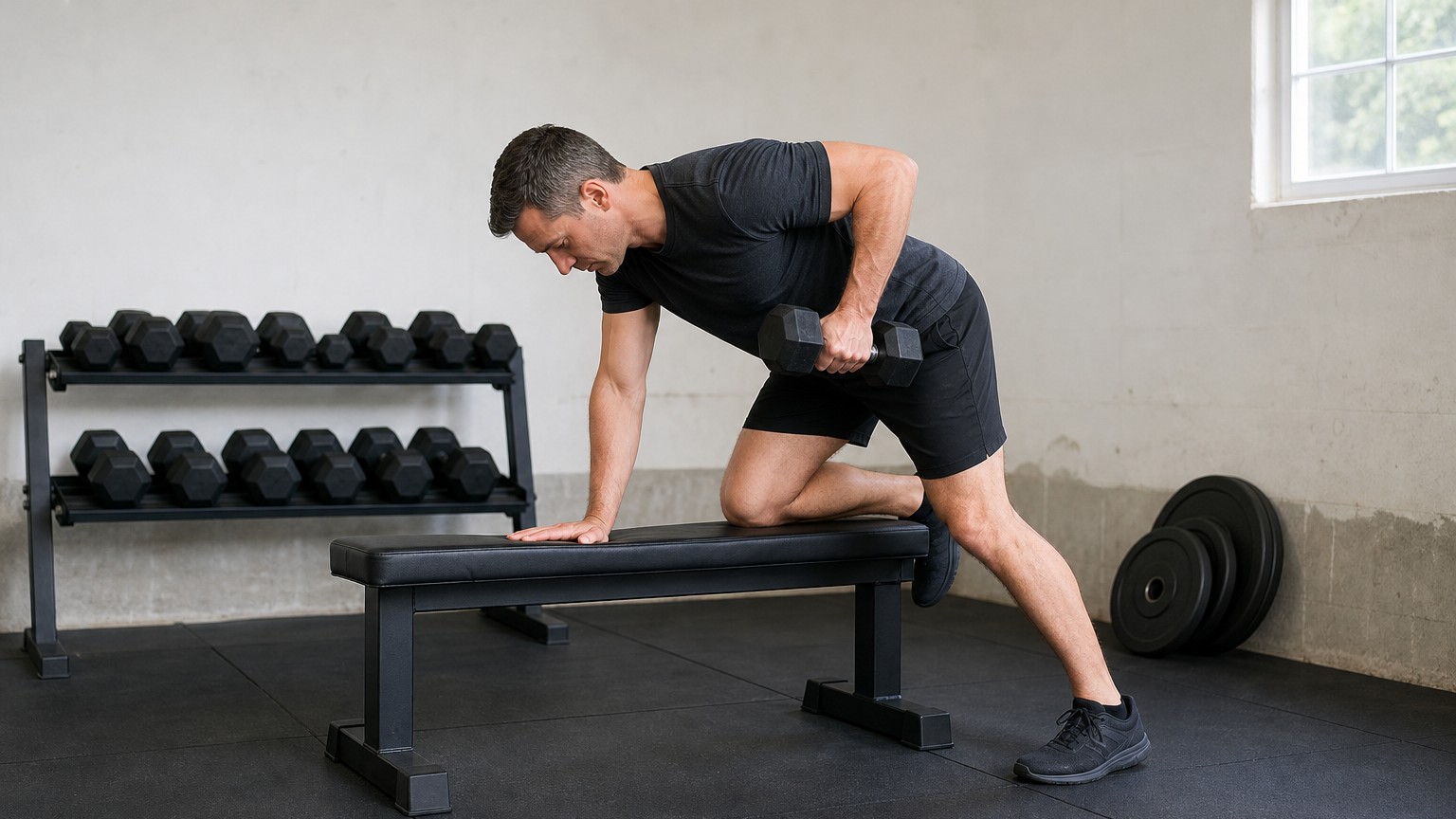
Of everything researchers have tested, strength training is the most reliable way to hold on to muscle. A recent trial found that just 12 weeks of progressive resistance training, combined with sensible nutrition, reduced the number of older adults with sarcopenia, per research published in 2025. The World Health Organization recommends muscle-strengthening activities that work all major muscle groups on two or more days a week for adults.
What matters is the principle, not a specific routine. You can use:
Weights or machines at a gym
Resistance bands at home
Your own body weight — push-ups, squats, lunges, planks
Start lighter than you think you need, and build up gradually. Two solid sessions a week, done consistently, beat a perfect plan you never follow.
Protein: How Much, and When
Your muscles need protein to repair and rebuild, and as you get older they become a little less responsive to it — researchers call this anabolic resistance. Put simply: you may need a bit more protein than you did at 25, and it helps to spread it through the day.
How much is “a bit more”? Protein needs vary with age, activity, health and goals, so there’s no single number for every man. A common guideline for healthy older adults who want to keep muscle is around 1 to 1.2 grams per kilogram of body weight per day, according to Harvard Medical School — a target, not a universal rule. If you have a health condition that affects what you should eat, follow your doctor’s or dietitian’s advice instead.
Good sources are simple ones:
- Eggs
- Lentils and beans
- Yogurt or curd
- Nuts and seeds
- Fish or lean meat
You don’t need protein powders for this. Real food, in sensible portions, is enough for most men.
Sleep, Stress and Recovery

Training gives your muscles a reason to adapt. Recovery gives your body time to do that work. When you don’t sleep, your body misses part of that repair window.
The science is real, if young: in a small study of healthy young adults, a single night without sleep led to a measurable drop in muscle protein synthesis and shifts in hormones that matter for muscle, per the study in question. One bad night doesn’t ruin your progress. But it does show that sleep is part of the training program, not an optional extra.
Chronic stress works against you too — often indirectly. Stress can make recovery harder when it disrupts sleep, training consistency or other healthy routines. If your weeks are relentless, protecting your sleep and finding ways to decompress count as training support. If you want the full picture of how stress shows up in your body and mind, our mental-health article covers it.
What About Testosterone?
Testosterone gets blamed for a lot of muscle loss, but it’s only part of the story. Testosterone levels tend to decline gradually as men get older, but for most men they remain within the normal range, according to Harvard Medical School. That slow, normal decline is not the main reason your lifts feel harder.
Clinically low testosterone is a different situation. It’s a medical diagnosis that requires real symptoms plus a properly confirmed blood test — not a guess based on a few hard workouts. If you’re worried, our article on the signs of low testosterone explains what to look for and when testing makes sense.
Don’t try to diagnose or treat suspected low testosterone yourself with over-the-counter “boosters.” If you’re concerned about symptoms, start with proper medical testing.
When Muscle Weakness Isn't Just Aging
Most gradual muscle loss is a normal part of aging. Some kinds of weakness are not.
Get emergency help immediately — contact your local emergency service — if weakness comes on suddenly, or if it comes with any of these:
Weakness or numbness on one side of the body
Drooping on one side of the face
Trouble speaking or understanding speech
Sudden trouble with balance or walking
These can be signs of a stroke, and every minute counts, per the Centers for Disease Control and Prevention.
Separately, gradual weakness deserves a medical check-up when it is:
Persistent or getting worse
Unexplained — nothing obvious has changed
Interfering with daily life, like struggling to stand from a chair or carry groceries
Thyroid problems are one example of a medical condition that can cause unusual weakness, as Mayo Clinic notes. A healthcare professional can assess whether something else may be contributing.
The Bottom Line
Muscle loss after 30 is real, gradual, and different for everyone. You can’t stop the clock, but you have more say than you might think:
- Train with resistance two or more days a week
- Eat enough protein, spread through the day
- Protect your sleep and manage stress
- Seek emergency help for sudden stroke-type weakness; get persistent or unexplained weakness medically checked
None of this requires a gym membership or a supplement shelf. It requires consistency. And that’s a message any man can act on.